
It has been an eventful year for markets, but price movements over the last several weeks have felt sharper than anything we have seen in some time. After a small group of stocks drove the market to successive all-time highs, a swift pullback pushed several stocks and indices into correction territory. This has forced investors to ask how well their portfolios are prepared for an uncertain future.
Our discipline is to own reasonably valued, durable businesses that allow clients to remain invested through periods like this. This helps contribute to a successful investment program via long-term compounding, even when the list of concerns on investors’ minds is long. That is certainly the case today. The complications/risk factors facing investors include: 1) stubbornly high inflation and a Federal Reserve (Fed) poised to keep rates elevated in response, 2) conflict in the Middle East and elsewhere, 3) a string of systems outages across U.S. industries, 4) uncertainty following the midterm elections, and 5) tumultuous events with Nvidia and its CEO that have fueled the AI debate.
That unease has now fallen hardest on the portfolios that captured the most upside. We call this a concentration unwind. As we wrote in early November, mature, cash-generative companies saw their valuations compress earlier this year as investors chased the beneficiaries of unprecedented corporate investment in AI. Since the end of the third quarter, that trend has begun to reverse. We are pleased that our strategies have held up very well through this period, consistent with how we would expect high-quality portfolios to behave when markets become less exuberant.
We believe the current stock market selloff feels jarring because index and active fund returns have masked underlying weakness for some time. Owning the small group of stocks that powered "diversified" portfolios higher enabled investors to participate in record highs. It also fostered large, concentrated positions across many portfolios that were less than fully diversified, whether or not end clients were aware of it. The pull to keep up with the market in a speculative period and to participate in a growth story is a powerful phenomenon. The chart below shows how the ten largest stocks’ combined share of the S&P 500 Index has changed over time. Many of those top ten stocks also became outsized positions in portfolios investors considered diversified and helped drive their strong returns.
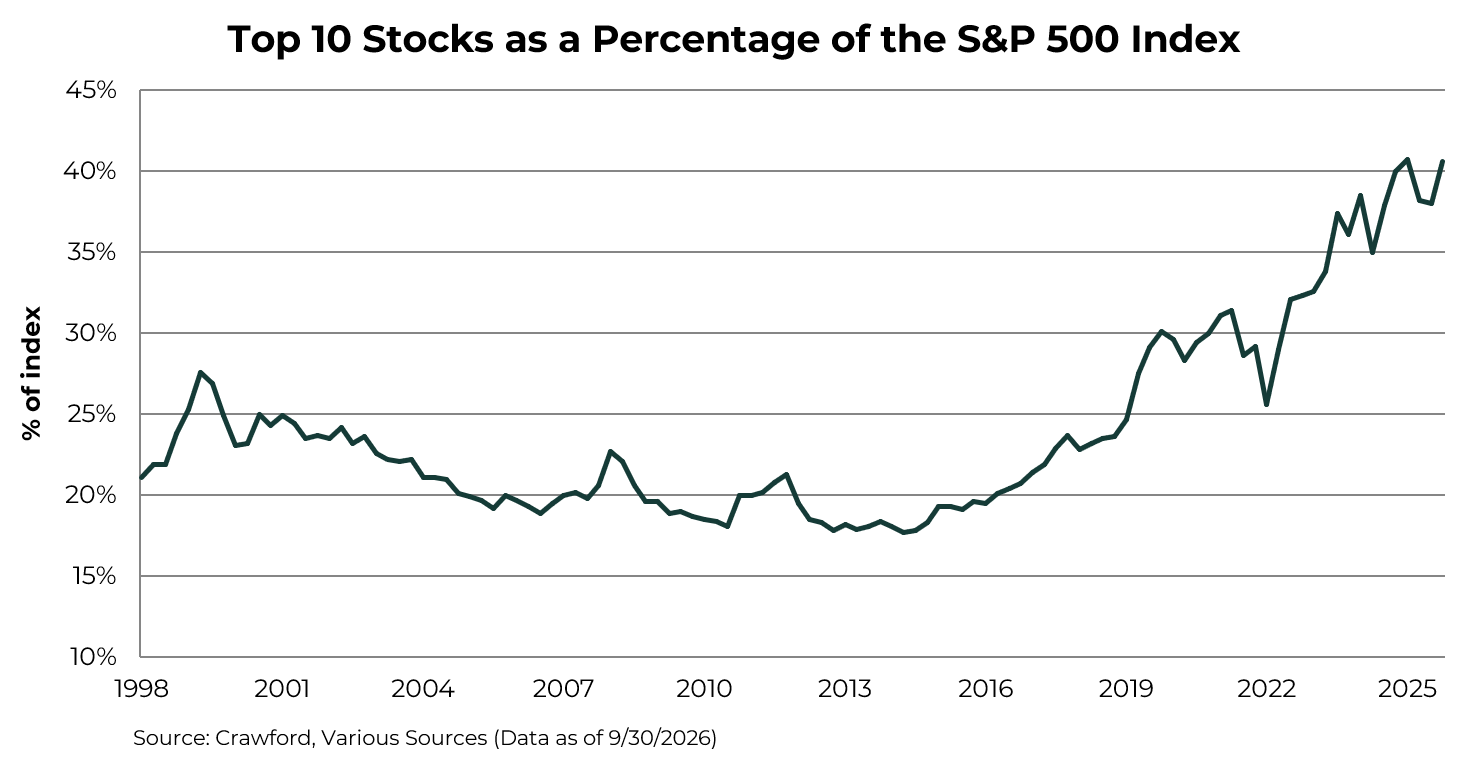
Broad stock market leadership is typically viewed as healthier than a small number of stocks leading the averages. However, there is no playbook that states how long the setup can last. This is part of the reason why we favor companies that are poised to earn growing profits somewhat irrespective of the market or economic backdrop. Even as these companies were growing their earnings and dividends, this approach proved to be a short-term headwind for relative investment returns in early 2026. Now, we are pleased to report that our discipline is again paying off for our clients.
Suffice it to say we are consoled to be invested in higher-quality securities. Our discipline means we may lag in narrow, momentum-driven markets. In return, we seek to participate in rising markets while limiting our clients' exposure to the full extent of the downside. That is how clients stay invested, avoid emotional decisions, and compound over full market cycles. As Warren Buffett put it, "Only when the tide goes out do you discover who's been swimming naked." As always, we will continue to invest according to our long-held philosophy, focusing on high-quality companies with durable cash flows, conservative balance sheets, and the ability to compound value over time.
We hope you and your families had a happy Thanksgiving as we look forward to a great holiday season.
Disclosures:
Crawford Investment Counsel Inc. (“Crawford”) is an investment adviser registered with the U.S. Securities and Exchange Commission. Registration does not imply a certain level of skill or training. More information about Crawford’s investment advisory services can be found in our ADV Part 2 and/or Form CRS, which is available upon request. The opinions expressed are those of Crawford Investment Counsel as of the date of publication and are subject to change due to changes in the market or economic conditions and may not necessarily come to pass. Forward-looking statements cannot be guaranteed. Past performance is not indicative of future results. There is no guarantee of the future performance of any Crawford portfolio. All investments involve risk, including loss of principal, and there is no guarantee that investment objectives will be met. CRA-2611-5

Mid-Quarter Update - May 2026
We have been struck by the number of seemingly contrasting signals within the economy and financial markets today.
Mid-Quarter Update - February 2026
We have been struck by the number of seemingly contrasting signals within the economy and financial markets today.

Mid-Quarter Update - August 2022
At midpoint in the third quarter we are very pleased that both stock and bond markets have recovered significantly from their June 30 low points.