

At Crawford Investment Counsel (Crawford), ours is a program focused on perpetual accumulation that is very much aligned with the needs of individual investors. We have talked a lot about the merits of investing in high-quality companies that exhibit dividend integrity and the necessity of reduced volatility, smooth patterns of return, and reducing the range of investment outcomes. These factors contribute to what we call the Perpetual Accumulation Approach, which is how we enable our clients to meet their investment objectives and achieve successful outcomes.
No two clients are alike, but our clients are almost always focused on two main objectives: growth and income. Another related theme in many of our clients’ investment programs is this: individuals have spending needs and limited time horizons but often also intend to leave a legacy. This creates a conundrum. Near-term assets should provide lifestyle maintenance, but long-term assets should be treated as permanent family funds.
Herein lies the issue: an investor intending to leave a legacy should be invested in longer-duration assets with the propensity for growth, but these assets typically exhibit a greater degree of volatility than short-duration assets. We believe excessive volatility in pursuit of higher, long-term returns is not an acceptable option for many investors, particularly those who have spending needs. Typically, these conflicting objectives would suggest investors put a greater degree of emphasis on accomplishing near-term objectives at the detriment of long-term goals. However, at Crawford, we believe that by investing in quality, employing a price-sensitive approach, and establishing a reasonable spending policy, our clients can have their cake and eat it too.
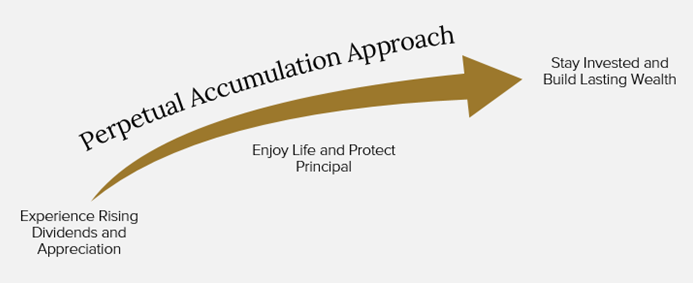
Experience Rising Dividends and Appreciation. We utilize a company’s dividend history as a litmus test for quality, so all of the companies we invest in return capital to shareholders through sustainable and rising dividends. While this helps accomplish the near-term objective of income, it also supports the long-term objective of capital appreciation. Investing in high-quality companies reduces the range of potential outcomes and allows clients to participate in the return trajectory of long-duration assets with far less risk. High-quality businesses are more likely to produce consistent returns year over year, regardless of market movements.
Enjoy Life and Protect Principal. Investing in high quality enables our clients to achieve perpetual accumulation of wealth. Sustainable and growing dividends allow our clients to benefit from the fundamental growth of the companies they are invested in and satisfy short-term income objectives. We like to think of ours as a “sleep well at night” approach.
Stay Invested and Build Lasting Wealth. At Crawford, we view timing the market as a fool’s errand and staying invested as paramount. Our approach has a low risk of abandonment because of its ability to meet objectives and dampen market swings. With the Perpetual Accumulation Approach, a client can stay invested, spend the income produced by the portfolio, avoid invading principal, grow the income over time, and ultimately grow assets over time.
The firm’s focus on quality and dividend growth was initially conceived to support a single client’s mandate for growth and income. Today, we believe it enables all of our clients to achieve these two objectives and experience rising dividends and appreciation, enjoy life and protect principal, and stay invested and build lasting wealth.
Please reference our related Podcast for more detail:
Disclosures:
Crawford Investment Counsel (“Crawford”) is an independent investment adviser registered under the Investment Advisers Act of 1940, as amended. Registration does not imply a certain level of skill or training. More information about Crawford, including our investment strategies, fees, and objectives, can be found in our Form ADV Part 2and/or Form CRS, which is available upon request.
The opinions expressed are those of Crawford. The opinions referenced are as of the date of the commentary and are subject to change, without notice, due to changes in the market or economic conditions and may not necessarily come to pass. There is no guarantee of the future performance of any Crawford portfolio. Crawford reserves the right to modify its current investment strategies and techniques based on changing market dynamics or client needs.
CRA-23-045

The Total Shareholder Return Trifecta
We invest to achieve an investment trifecta by selecting stocks that provide our investors with all three components of total investment return: fundamental business progress or growth, dividend yield, and valuation improvement

The Dividend Effect
The Dividend Effect insulates investors from much of the volatility typically associated with investing.

When a Stock Becomes a Ninja
With a ninja strategy, we hope to win by investing in companies that are better equipped to avoid problems in the event of an economic downturn.