In this piece, we take key points from our firm's most recent Bond Policy Meeting and share them with our readers. Hopefully, this piece will provide some insight into the economy and fixed income markets and give you a sense of how our team is thinking about recent trends and developments.
Crawford Bond Policy
- Current or future disruption from geopolitics not withstanding, we believe the U.S. economy should continue to perform well sustained by the following:
- A continued full employment picture
- Increased productivity and meaningful AI-related capex
- A confident consumer supported by a solid personal financial picture
- Corporate profitability reaching record levels
- We believe this is likely to be a "coupon and carry" year for the bond market, meaning performance is likely to be driven by coupon income and securities rolling down the curve (resetting to shorter duration benchmarks).
- Consequently, our focus has shifted to positioning for yield maximization and rolldown characteristics as opposed to taking on additional market risk through duration extension.
- Inflation is elevated and could be negatively impacted by increased oil and commodities prices driven higher by the war with Iran. The cost of the war could add to the debt and deficit management narrative which has pushed the term premium higher on longer duration bonds.
Treasury Market
- The conflict with Iran, which commenced on February 28th, has single-handedly stolen the narrative on the U.S. economic outlook from the debate over whether AI-driven productivity will be enough to offset tepid labor force growth.
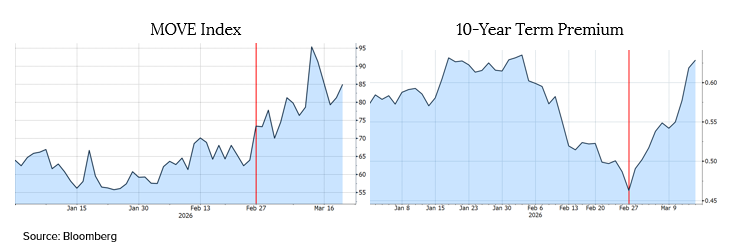
- Bond market volatility, as measured by the MOVE Index (see below), has increased in addition to the term premium (see below) demanded by investors for the lack of predictability and threat war expenses could be to fiscal management.
- On the day before the beginning of the conflict, Fed Funds Futures were pricing in a total of two 25 basis point cuts with a 44% chance of a third cut. As of March 20th, no cuts are priced-in for 2026 and there is now a 19% chance of a 25 basis point hike priced-in.
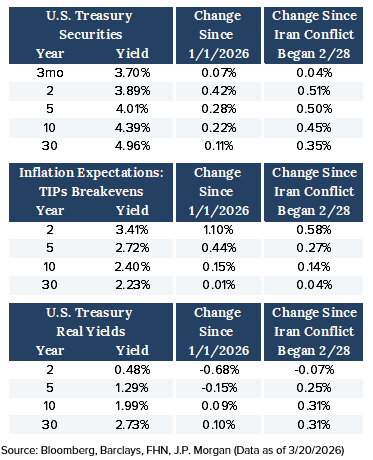
- Yields are higher across the Treasury curve since the beginning of 2026. The beginning of the Iran conflict ended a month-long rally in Treasury securities which saw some of the lowest yields since the third quarter of 2024.
Investment Grade Corporate Bond Market
- Investment grade corporate bond spreads (yield compensation for credit risk) have widened since early February, reflecting significant new issue supply and risks associated with the Iran conflict.
- Investment-Grade issuance the week of March 9th reached a post-COVID high, with Tuesday, March 10th recording the largest single day of issuance on record.
- New issue demand remains strong with deal metrics comparable to 2025.
- Fundamentals remain strong
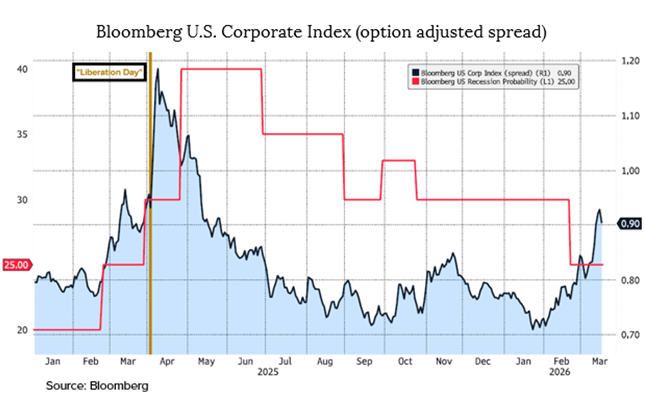
- Except for a brief spike after the initial tariff policy announcement in April 2025, investment-grade credit spreads have been widely regarded as very compressed following the Fed 2022-2023 tightening cycle.
- The chart below attempts to illustrate a historical context for the yield earned on the Bloomberg U.S. Corporate Index relative its combined market risk (adjusted modified duration) and credit risk (option-adjusted spread).
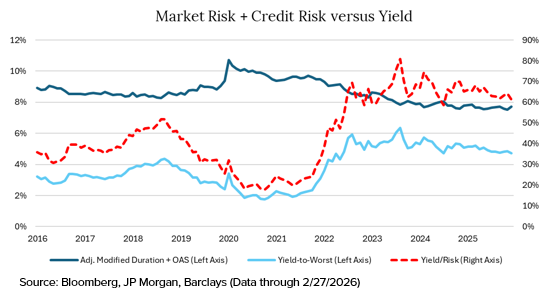
- The data illustrated by the chart suggests current yield compensation as a percentage of combined market and credit risk is actually very good.
- Conclusion: Absolute investment grade corporate yields are attractive and compensating for risk.
Municipal Bond Market
- The Municipal bond market started the year solidly supported by the continuation of the strong investor demand exhibited through the later half of 2025.
- This demand persisted through the end of February as record level reinvestment funds outran robust new issue supply.
- The tone changed with the beginning of the war in Iran as the U.S. Treasury market began to exhibit higher volatility, and high-volume new issue activity in the municipal market persisted.
- The chart below illustrates yield behavior for generic 2 and 10-year “AAA” rated bonds year-to-date. Seasonal tax-time effects and continued uncertainty regarding the conflict in Iran will likely maintain upward pressure on yields.
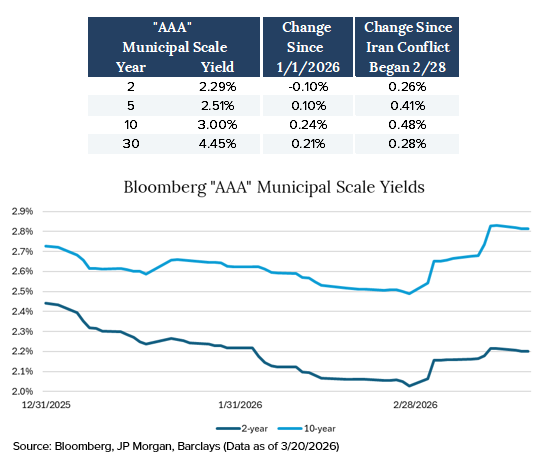
- Fundamentally, the high-grade Municipal market remains in good shape supported by the health of the U.S. economy and consumer.
- Pockets of weakness are beginning to emerge, however, as some state and local issuers are exploring options to strengthen finances as budget shortfalls emerge from decreased Federal funding.
- New issue supply is expected to continue the trend experienced over the past couple of years driven primarily by “new money” issuance needs versus refundings. The Municipal market is expected to reach $4.6Trillion in size by the end of 2026.
DOT Plot and Summary of Economic Projections (SEP)
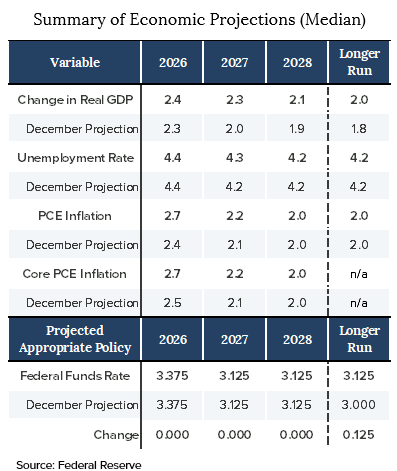
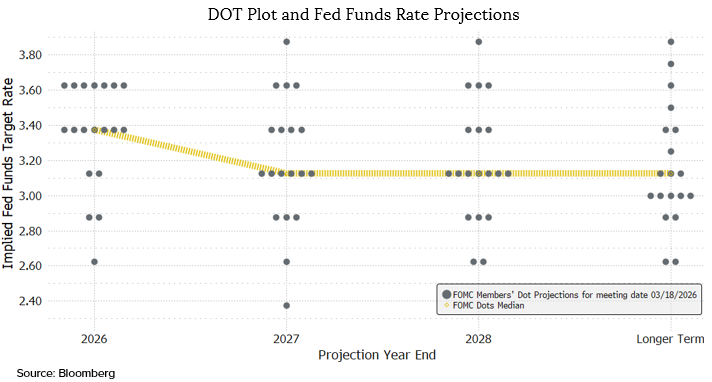
- There was no change in median Fed funds rate expectations except for the long-run (neutral) rate, which moved higher by 0.125%.
- The forecast for GDP growth rose from 2.3% to 2.4% for 2026, driven by a rebound from the government shutdown and expectations for AI investment. GDP projections moved higher for 2027, 2028, and long-term, driven by expectations for higher productivity.
- It seems counter-intuitive for the Fed to be projecting higher future productivity alongside increased inflation. The forecast for inflation does eventually come down, but the short-term increase is driven from the timing of having one-time tariff effects fall out.
Disclosures:
Crawford Investment Counsel (“Crawford”) is an independent investment adviser registered under the Investment Advisers Act of 1940, as amended. Registration does not imply a certain level of skill or training. More information about Crawford, including our investment strategies, fees, and objectives, can be found in our Form ADV Part 2and/or Form CRS, which is available upon request.
The opinions expressed are those of Crawford. The opinions referenced are as of the date of the commentary and are subject to change, without notice, due to changes in the market or economic conditions and may not necessarily come to pass. There is no guarantee of the future performance of any Crawford portfolio. Crawford reserves the right to modify its current investment strategies and techniques based on changing market dynamics or client needs.
Material presented has been derived from sources considered to be reliable, but the accuracy and completeness cannot be guaranteed.
CRA-2603-8

Crawford Bond Policy Update
Crawford's bond policy reflects the firm's stance on the fixed income markets, interest rates, inflation, and more.

September Bond Policy Update
Crawford's bond policy reflects the firm's stance on the fixed income markets, interest rates, inflation, and more.

November Bond Policy Update
Crawford's bond policy reflects the firm's stance on the fixed income markets, interest rates, inflation, and more.