

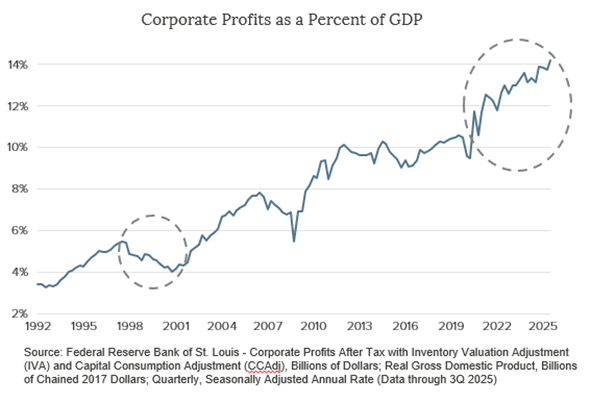
Take a close look at the chart below. Let it sink in because it is a remarkable picture. Corporate profits as a percentage of real Gross Domestic Product (GDP) have risen from less than 4% to over 14% over the course of the 33 years shown. In other words, total corporate profits have grown meaningfully relative to the size of the overall economy. While the trend has been interrupted by recessions, as is normally the case, the picture spans a sufficient length of time to be considered a secular trend. Let’s look at some of the reasons behind the consistent rise in corporate profits and the likelihood of their persistence.
This paper is an update of one published four years ago titled The Corporate Juggernaut, Can It Be Stopped? In that paper, we summarized several reasons behind the steady and superior rise in profits relative to GDP. Among these were increased leverage, growing monopoly and monopsony power, lower corporate taxes, the benefits of globalization, and diminished regulation. But our main focus was on the longer-term trend of declining worker power. Declining worker power is a way of describing a major shift from labor to capital that has been going on in our economy for decades. This trend can be observed in the sluggishness of real wage growth, declining share of national income by labor, and shrinking unionization.
The above-mentioned factors remain in place, but in this piece, we introduce a different reason behind the continuing ability of corporate America to increase its share of the overall economic pie. In a recent paper by Chris Brightman and Alex Pickard1, they make the case that a structural shift in the savings/investment relationship in our country, as represented by continuing large fiscal deficits and reduced corporate investment, has been one of the most important forces behind corporate profit growth. The paper goes on to conclude that the lack of investment has led to the use of the profits by corporations in ways that result in the financialization of the economy. That is a topic for future consideration, but for now, note the table below that demonstrates consistently rising profits going back to the decade of the 1950s, coincident with increasing deficits.
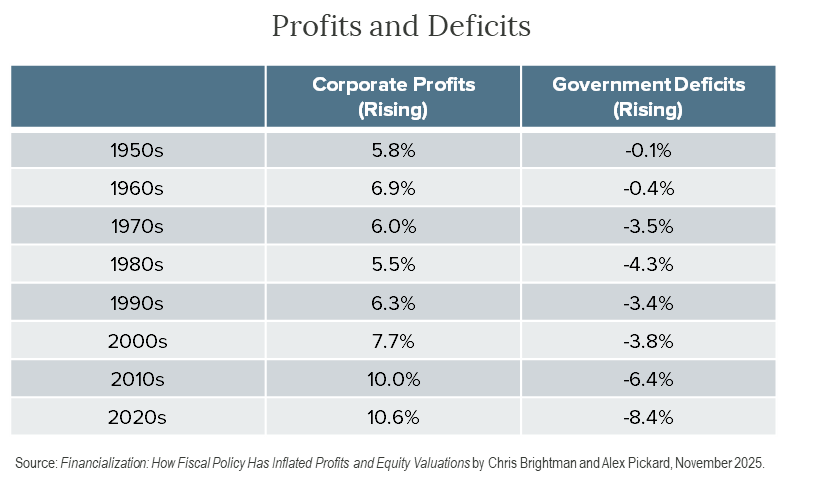
The message from the table is clear: as federal budget deficits have increased, so have corporate profits. But why? Deficit spending is, by nature, stimulative for the economy, and the corporate sector benefits from it. Think of it this way: when the federal government runs fiscal deficits, the Treasury funds the deficits by selling Treasury securities to the public. They take the proceeds of these sales and distribute them into the economy. A large portion of these distributions goes out in the form of Social Security and Medicare payments, mainly to the lower income demographic, which is much more inclined to consume than to save. Corporations are the beneficiaries of this process as they reap increased revenues from consumers spending the distributions. It is this constant flow of deficit distributions that helps fuel corporate revenue growth and profits. The higher the deficits, the more benefits flow to the corporate sector. The figures in the table certainly suggest a correlation between rising federal deficits and growing corporate profits.
Two periods on the chart above are supportive of the theory. Refer back to the first chart we show with Corporate Profits as a Percent of GDP. Notice that at the turn of the century, when the federal government last ran a budgetary surplus, corporate profits as a percentage of GDP declined. Next, fast forward to the post-Covid period, when corporate profits as a percentage of GDP have accelerated dramatically. Not coincidentally, this was a period of massive fiscal stimulus, resulting in some of the largest peacetime deficits in history.
Regardless of the reasons behind the seemingly inexorable rise in corporate profits, for investors in common stocks, it is a good thing. A rising trend in corporate profits is inevitably accompanied by a rising trend in the stock market. This trend is not one for one, but over time, higher profits justify higher stock prices. The way things have worked out over the last 33 years provides a nice ladder of economic growth leading to increasing profitability for corporations and even better returns from common stocks. Over this period, the real economy has grown right around 2%, the nominal economy (add in 3% inflation) has expanded around 5%, corporate profits have grown at 7%, and common stocks have compounded at 11%. The higher return for stocks reflects the addition of dividends, buybacks, and valuation changes. What more needs to be said? We join all investors in wishing for a continuation of corporate profit expansion.
What might interrupt or cancel the positive trend in corporate profits? Well, if Brightman and Pickard are correct, it would be negative for corporate profits if fiscal rectitude were to be adopted by our federal government. It has long been feared that there would eventually be a day of reckoning if our government were to continue to run large fiscal deficits. This fear, yet to be realized, has been that unchecked growth in federal indebtedness would eventually lead bond investors to revolt. A bond market riot that forces higher interest rates could result in more responsible fiscal action, leading to a shift toward less deficits. This, in turn, could be harmful to the corporate sector and, by inference, to the stock market as well. If fiscal support were to be withdrawn or curtailed, the stock market would likely be vulnerable.
Currently, there are no signs of a change in fiscal priorities, and the other elements cited in our previous paper remain in place. We view common stocks as organic entities, capable of taking advantage of a growing economy to produce an expanding stream of profits. We expect this dynamic to remain in place for the foreseeable future.
Our purpose in this paper is to continue to explore the question of the sustainability of U.S. corporate growth at a faster pace than overall economic growth, because of its importance to all of us as investors.
Disclosures:
Crawford Investment Counsel Inc. (“Crawford”) is an investment adviser registered with the U.S. Securities and Exchange Commission. Registration does not imply a certain level of skill or training. More information about Crawford’s investment advisory services can be found in our ADV Part 2 and/or Form CRS, which is available upon request. Additional information can be found at www.crawfordinvestment.com.
The opinions expressed are those of Crawford Investment Council Inc. (“Crawford”). The opinions referenced are as of the date of publication and are subject to change due to changes in the market or economic conditions and may not necessarily come to pass. Forward-looking statements cannot be guaranteed.
CRA-2604-45

Inflation Worries: Real or Imagined?
Investors are currently engaged in an interesting conversation, one that addresses what could be a major shift in the economic profile of our country.

The U.S. Remains a City on a Hill
U.S. exceptionalism, whether thought of in its broader original context, or the more restrictive financial and economic context, is essential to the future well being of our country.

Innovation & Transformation: Investing in AI
Given the pace of innovation and the rapid adoption of generative AI technologies, now is an exciting time to be an investor in companies with AI exposure. At Crawford, we can take advantage of these opportunities by identifying individual companies that both meet our quality requirements AND participate in these secular growth markets.