

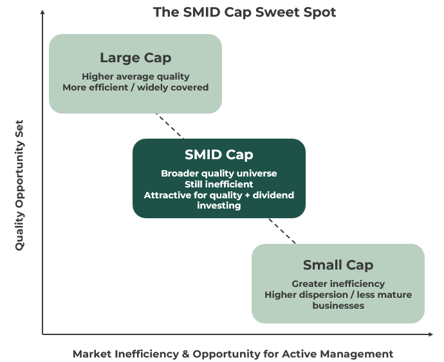
Investors tend to think about market capitalization along a relatively straightforward spectrum. Large capitalization companies are generally perceived as established, stable, more mature, and well understood. Smaller capitalization companies are associated with greater growth potential, but also greater risk. Between these two ends of the market spectrum lies the small-to-mid capitalization, or SMID cap universe. We believe this area of the stock market offers a particularly attractive environment for investors and, more specifically, is particularly well suited to Crawford’s quality- and dividend-oriented investment philosophy.
By focusing on high-quality, dividend-paying companies within this broad and relatively inefficient universe of small-to-medium sized companies, we believe investors can access one of the more attractive intersections of opportunity and risk control available in the equity market. This stems from a compelling combination of characteristics, including a broader opportunity set of companies that are in a sweet spot of growth and consistency.
Smaller companies can offer substantial growth potential, but the smallest areas of the market also contain a higher proportion of companies with unproven business models, greater financial leverage, inconsistent profitability, limited access to capital, or greater sensitivity to the economic cycle. As the opportunity set expands into mid capitalization companies, the quality profile changes considerably. Investors gain access to businesses that may still have meaningful room to grow, but which are further along in their corporate development. Many have established competitive positions, seasoned management teams, stronger balance sheets, more consistent free cash flow generation, disciplined capital allocation, and a demonstrated commitment to shareholders through dividends. In summary, the universe of high-quality SMID cap companies includes many companies that enjoy the characteristics of more mature businesses but have the growth potential often associated with smaller capitalization companies.
Within this already attractive opportunity set, we believe the dividend can provide an additional advantage. We acknowledge that it can be somewhat counterintuitive to invest in dividend-paying smaller companies. Some investors believe that businesses at this stage of their development should reinvest all available capital back into the company rather than return it to shareholders. However, Crawford has long viewed a company’s ability to consistently pay and increase its dividend as an important indicator of underlying business quality and shareholder alignment. We believe a company that can fund its growth opportunities while also consistently paying a dividend is often demonstrating an important combination of characteristics. The dividend can provide evidence of healthy free cash flow generation, durable earnings, balance sheet strength, and a business model capable of supporting both reinvestment and shareholder returns. It can also signal confidence in the company’s future cash-generating ability, while reflecting a shareholder-friendly management team with a disciplined approach to capital allocation.
Our approach also contrasts with a common tendency among investors. Small and mid cap companies are often sought for their upside potential, which can lead investors toward more speculative businesses with a wider range of potential outcomes. This tendency to favor higher-risk, higher-upside opportunities can leave higher-quality companies comparatively overlooked, creating potential inefficiencies that a disciplined, quality-focused approach can seek to exploit. In our view, quality and dividends are crucial because they can help narrow the range of potential outcomes while preserving exposure to the growth potential that makes smaller companies attractive. Our emphasis on quality becomes increasingly important further down the capitalization spectrum, where business and financial risks are often greater
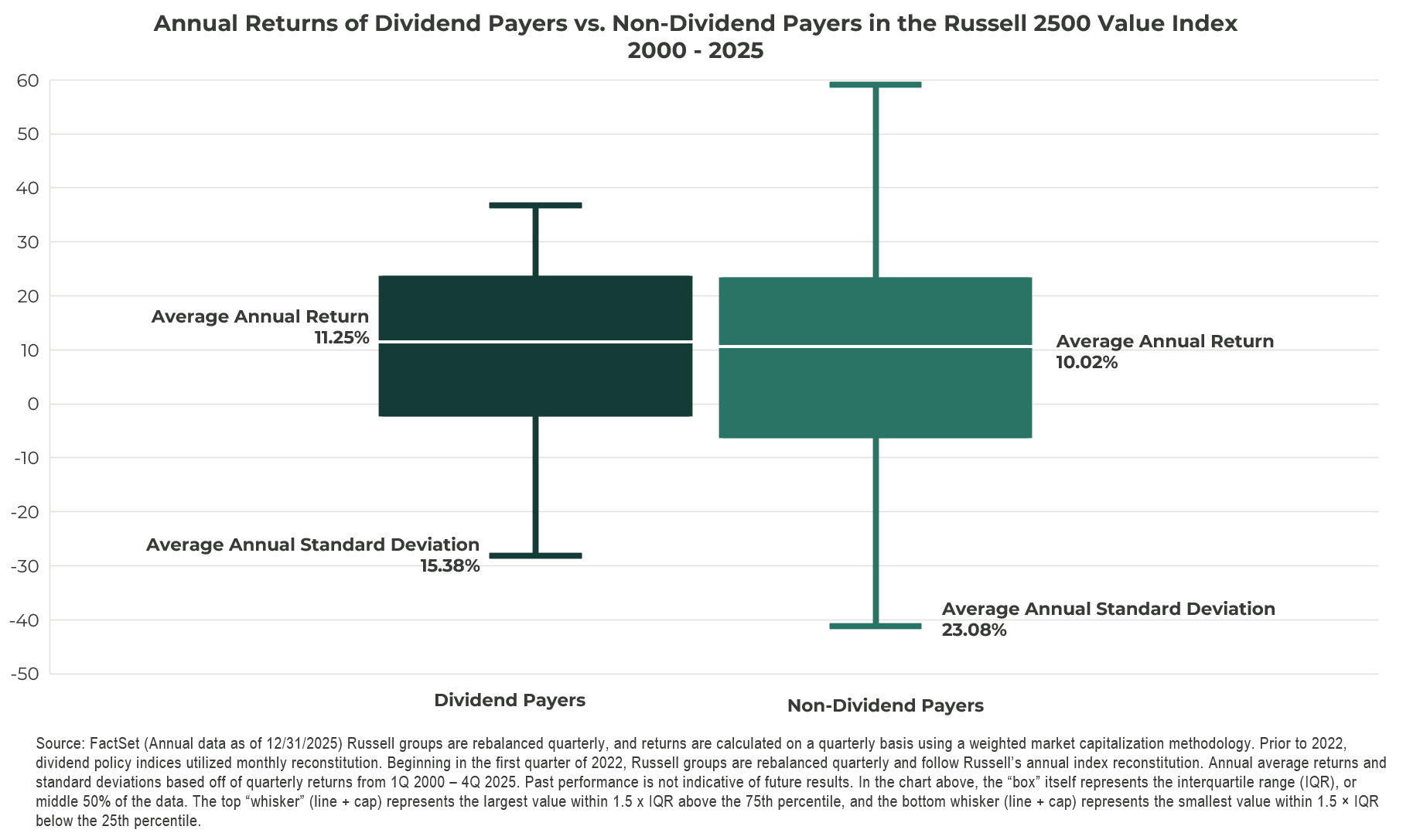
Our research supports this view. Historically, dividend-paying companies within the SMID cap universe have generated favorable returns with lower risk than their non-dividend-paying counterparts.
SMID companies generally receive less analyst coverage and investor attention than larger companies, creating greater potential for individual securities to become misunderstood or mispriced. This is where the different elements of Crawford’s approach come together. A broad universe gives us more companies from which to choose. Less investor attention and lower market efficiency can create attractive individual security opportunities. At the same time, our emphasis on quality helps us avoid many of the fundamental risks associated with smaller companies. And our dividend discipline provides an additional indication of financial strength and shareholder orientation. Finally, our value orientation further mitigates risk. Each characteristic is valuable independently, and we believe their intersection is particularly compelling.
For investors seeking a balance of return potential, quality, diversification, and risk control, we believe the Crawford SMID Cap strategy occupies a particularly attractive position. It is large enough to contain a deep and diverse collection of established, high-quality businesses, yet small enough that market inefficiencies remain meaningful. Combined with a disciplined focus on quality and dividends, we believe these characteristics make the SMID cap universe an especially compelling environment for fundamental, active investment management.
Disclosures:
Crawford Investment Counsel Inc. (“Crawford”) is an investment adviser registered with the U.S. Securities and Exchange Commission. Registration does not imply a certain level of skill or training. More information about Crawford’s investment advisory services can be found in our ADV Part 2 and/or Form CRS, which is available upon request. The opinions expressed are those of Crawford Investment Counsel as of the date of publication and are subject to change due to changes in the market or economic conditions and may not necessarily come to pass. Forward-looking statements cannot be guaranteed. Past performance is not indicative of future results. There is no guarantee of the future performance of any Crawford portfolio. All investments involve risk, including loss of principal, and there is no guarantee that investment objectives will be met. CRA-2609-4

An Extreme Environment
As investors in high quality small cap companies, we have faced a uniquely challenging environment since the beginning of the COVID-19 pandemic.

Innovation & Transformation: Investing in AI
Given the pace of innovation and the rapid adoption of generative AI technologies, now is an exciting time to be an investor in companies with AI exposure. At Crawford, we can take advantage of these opportunities by identifying individual companies that both meet our quality requirements AND participate in these secular growth markets.

High and Rising Income: Crawford Dividend Yield Strategy
In this strategy, growth of income is achieved by owning companies that increase dividends regularly, and it is buttressed by our active management process.