

The Dividend Growth Strategy’s fundamental, bottom-up research process begins with a universe of companies that have demonstrated a long-term commitment to shareholders through at least ten years of stable-to-rising dividend payments. Not only do we view this as an initial indicator of business quality and shareholder orientation, but we hold the belief that a company that consistently returns cash to shareholders must generate the financial resources necessary to support that commitment. As such, the dividend can impose a degree of capital allocation discipline by requiring management teams to balance reinvestment in the business with the return of cash to shareholders, potentially limiting the amount available for less productive uses.
We generally seek companies with proven track records of generating sufficient cash to reinvest internally for sustainable growth, support a healthy dividend, and pursue other shareholder-friendly forms of capital deployment. For this reason, we view free cash flow as the lifeblood of a company and a central consideration in both our company and valuation analysis. Dividend history indicates what a company has been able to return to shareholders, whereas free cash flow helps us evaluate the financial engine supporting that return and its potential to grow over time. We are particularly interested in situations where a company appears positioned to transition to a faster pace of free cash flow growth.
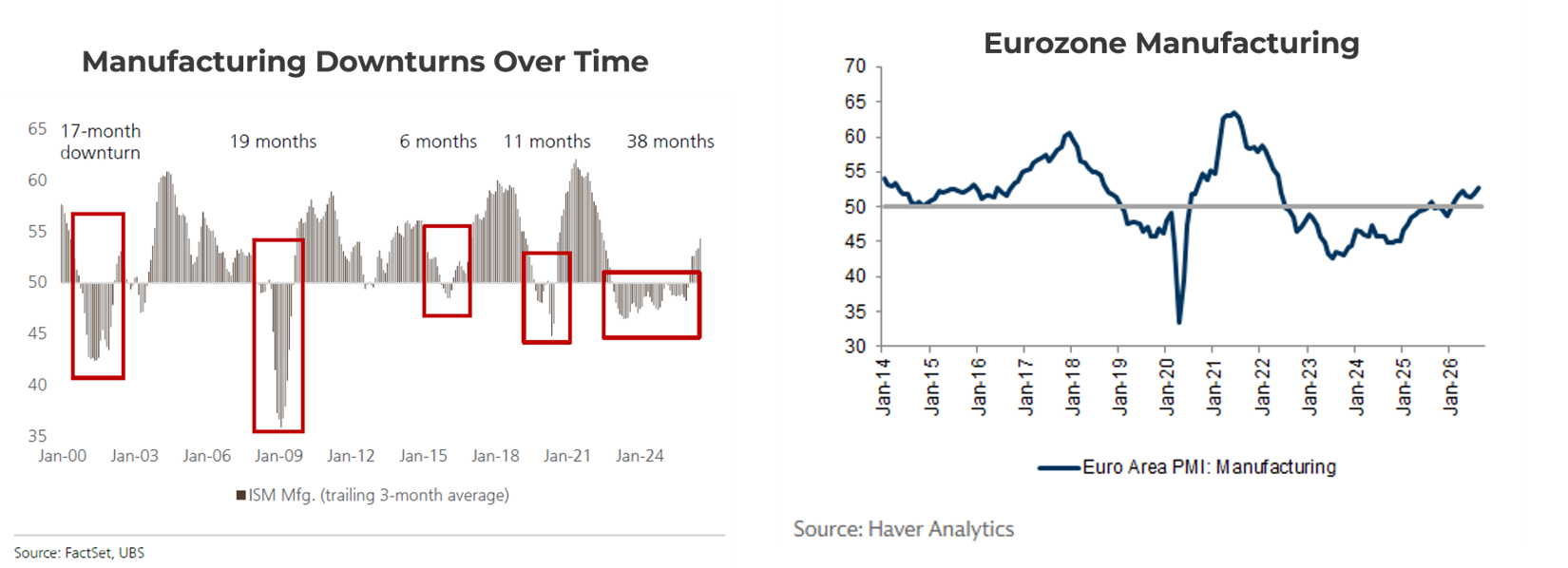
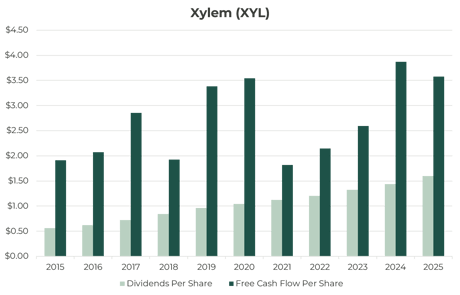
Applying these standards has recently led us to several attractive investment opportunities within the Industrials sector. Over the past year, we have added three industrial stocks to the strategy: Dover (DOV), Xylem (XYL), and Paychex (PAYX). These holdings are the result of our commitment to individual stock research, but the opportunities have also emerged against a backdrop of weaker global manufacturing activity following the post-pandemic demand surge, compounded more recently by uncertainty surrounding U.S. trade and tariff policy. The charts below highlight these trends. In each case, our research identified what we believe is an attractive combination of business quality, valuation, and future free cash flow potential.
It may be surprising that nearly a quarter of the 400 Dividend Growth universe constituents are Industrials. We believe this reflects the attractive cash flow characteristics of many established medium-sized and larger industrial businesses. Most of these companies maintain relatively conservative dividend payout ratios, leaving greater flexibility to reinvest in the business while preserving their ability to maintain and grow dividends through inevitable economic downcycles. We believe this combination of cash generation and dividend coverage is particularly important in a sector where earnings can fluctuate with the economic cycle.
The Dividend Growth strategy currently holds a 17% exposure to the Industrials sector, following the inclusion of these three stocks. Importantly, this increased exposure is the result of individual security selection rather than a top-down sector view. This distinction is particularly relevant today, as many industrial companies are increasing capital spending to participate in the buildout of data centers and related infrastructure. While this investment may ultimately yield attractive returns as AI-related demand continues to grow, elevated capital expenditures weigh on near-term free cash flow, and historically, prolonged periods of high capital spending have also coincided with weaker stock performance.
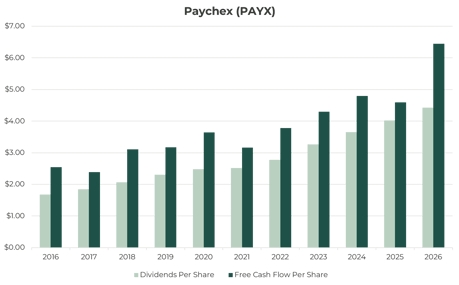
For us, this creates an important distinction between companies still consuming significant cash to fund expansion and those currently experiencing or approaching a point where prior investments may begin to translate into stronger free cash flow. Paychex is a leading outsourced payroll and human resources services provider for U.S. small businesses, serving employers that collectively account for more than 10% of private sector workers. While some investors have viewed the business as being vulnerable over time to encroachment by AI-driven products, we view the company as an AI beneficiary, as it is actively leveraging its deep proprietary data collected over decades of serving millions of workers to provide incremental value-added services to clients that rely on the efficiency Paychex offers to their resource-constrained operations. Paychex is among the most consistent dividend growers in the market, and dividends represent the cornerstone of its capital allocation strategy, enabled by highly consistent free cash flow generation supported by high customer retention and strong profitability. The chart below reflects Paychex’s level of success in leveraging a sizable acquisition into faster cash flow growth in its most recent fiscal year, which also reinforced investor confidence in the company’s ability to support its attractive dividend.
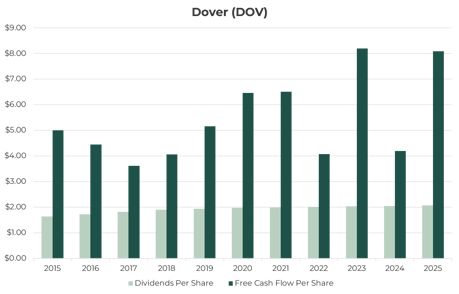
Dover and Xylem are examples of industrial companies positioned for improved free cash flow growth following the completion of capacity expansion projects, business restructuring, and other uses of capital. Both companies also possess strong balance sheets that provide flexibility for increased shareholder-friendly capital deployment through dividend growth, acquisitions, and significant share repurchases.
Dover is a diversified equipment manufacturer participating across many end markets including liquid flow control, plastics handling, biopharma processing, refrigerated cases, metal cans, and clean energy, among others. While gradually enhancing the portfolio through acquisitions of faster-growth and higher-profit-margin businesses, we believe the company possesses 10%+ free cash flow growth potential over at least the next few years. We believe this combination of improving cash generation and disciplined capital deployment creates an attractive setup for long-term investors.
Xylem is a global leader in water infrastructure products and services. While the company has been quite successful with profit margin improvement in recent years, sales growth has been limited due to an internal focus on optimizing its customer base and product portfolio, leading to divestitures and reductions in the number of products sold (especially those with lower levels of profitability). As a result, near-term growth limitations have left the stock out of favor with investors. We expect sales to reaccelerate in coming quarters and continued margin improvement to support a mid-teens pace of free cash flow generation in coming years. If this occurs, we believe the improvement in underlying fundamentals could ultimately attract greater investor attention.
The Dividend Growth strategy is focused on both downside protection as well as upside market participation. As a result, it is reasonable to ask whether the additional exposure to Industrials from investments in Dover, Xylem, and Paychex undermines the strategy’s downside-oriented characteristics. We do not believe it does.
Dover has historically exhibited moderate economic sensitivity, but the current management team has taken many steps to evolve the diverse collection of businesses away from some more cyclical demand types of equipment through divestiture and towards health care and consumables, which represent less-economically sensitive sources of demand. The stock’s valuation relative to large cap stocks in general is also below historical levels.
As a water infrastructure provider, Xylem benefits from several stabilizing sources of demand, including water scarcity, the critical importance of water infrastructure, predictable equipment and parts replacement cycles, and recurring service revenue. These characteristics provide a degree of insulation from broader economic volatility. In addition, Xylem’s relative valuation is at historically low levels.
Lastly, while small business employment is cyclical and selling incremental services can become more difficult during weaker periods, Paychex provides essential outsourced HR services that many clients are reluctant to replace with lower-cost alternatives that could disrupt mission-critical payroll or employee functions. This value proposition is reinforced by the company’s ability to raise prices across economic environments, as well as consistently high and improving client retention. At the same time, investor concerns around potential AI disruption have contributed to historically low relative valuations.
While these are three different businesses, all have demonstrated a commitment to shareholders, possess strong financial characteristics, and we believe offer attractive prospects for future free cash flow generation and deployment. The recent increase in our Industrials exposure reflects the application of our longstanding fundamental, bottom-up research process to individual opportunities as they emerge. In each case, we believe the combination of business quality, free cash flow potential, disciplined capital allocation, and attractive valuation offers the potential for long-term appreciation while remaining consistent with the strategy’s emphasis on downside protection and risk management.
Disclosures:
Crawford Investment Counsel Inc. (“Crawford”) is an investment adviser registered with the U.S. Securities and Exchange Commission. Registration does not imply a certain level of skill or training. More information about Crawford’s investment advisory services can be found in our ADV Part 2 and/or Form CRS, which is available upon request. The opinions expressed are those of Crawford Investment Counsel as of the date of publication and are subject to change due to changes in the market or economic conditions and may not necessarily come to pass. Forward-looking statements cannot be guaranteed. Past performance is not indicative of future results. There is no guarantee of the future performance of any Crawford portfolio. All investments involve risk, including loss of principal, and there is no guarantee that investment objectives will be met. You should not assume that any of the securities transactions, sectors or holdings discussed in this report are or will be profitable, or that recommendations we make in the future will be profitable or equal the performance of the securities listed in this report. There is no assurance that any securities, sectors or industries discussed herein will be included in or excluded from an account’s portfolio. The securities discussed do not represent the account’s entire portfolio. This is not a recommendation to buy or sell a particular security or sector. All holdings for the last 12 months are available upon request, and more information on the strategy is available here. CRA-2609-3

The Dividend Growth Strategy: Maintaining and Growing Income in Recessions
The Dividend Growth strategy represents a pure implementation of the company investment philosophy

Example of Investment Thesis: AstraZeneca
In the first installment of the Company Fundamental Investment Series, Senior Research Analyst and Director of Core Equity Strategy, Frank Pinkerton, walks us through an investments thesis.

Tariffs & Turbulence: Why Quality Counts
Considering the potential effects of tariffs only serves to underscore the importance of our fundamental, bottom-up research process and high level of scrutiny in our company due diligence and investment decision-making process.