
In this piece, we will explore why today’s mixed economic and market signals feel confusing, and what matters most for investors. If the economy feels hard to read right now, you are not imagining it. There are various crosscurrents, and together, they suggest an economy that is slowing in feel, but not in fact.
On one hand, recent Gross Domestic Product (GDP) data shows the U.S. economy growing at its fastest pace in two years, driven largely by continued consumer spending. On the contrary, consumer confidence has been falling steadily, with households expressing increasing concern about jobs and business conditions. Inflation and gradually rising unemployment validate the angst. The figures below illustrate this contrast clearly. In short, people feel uneasy, even as the economy continues to move forward.
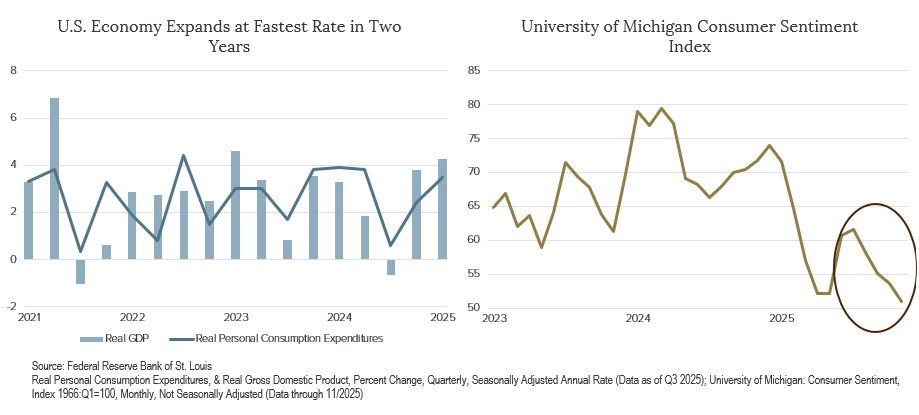
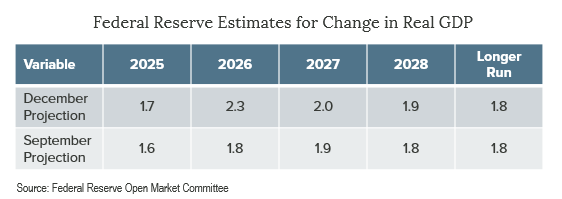
Why Both Things Can Be True: Economists believe this tension may persist. Hiring is expected to remain subdued, yet overall economic growth is still projected to continue into next year. In fact, at its December meeting, the Federal Reserve (Fed) raised its median estimate for economic growth in 2026, signaling more confidence in the economy’s underlying momentum.
What is driving the disconnect? One possibility is productivity, as companies are finding ways to produce more without adding as many workers. Advances in technology, automation, and Artificial Intelligence (AI) are playing a growing role, allowing businesses to grow their earnings with the same amount of manpower (or, in some cases, even less).
For investors, this matters because it means traditional warning signs do not always behave as expected. This environment also makes life harder for the Fed. In theory, the Fed can lower short-term borrowing rates to bolster employment, at the expense of increasing inflation (and perform the opposite when taming inflation is paramount). If future economic growth is driven largely by productivity gains, policymakers may see a less direct relationship between employment and rates. This dynamic has the potential to enhance market volatility as investors adjust expectations around rates, growth, and inflation.
What This Means for Markets: Overall, the backdrop can still be constructive for capital markets. A growing economy generally supports corporate earnings, and several positive forces remain in place: continued investment in AI, fiscal support flowing to consumers, and legislation that encourages business investment.
At the same time, we remain mindful of risks. Historically, election cycles tend to bring higher market volatility, and no economic expansion lasts forever. The U.S. has not experienced a true recession since 2008–2009. Eventually, that must change. The mistake many investors make is trying to guess when. Markets are constantly recalibrating, and missing a handful of strong periods can materially impact long-term outcomes.
What This Means for Our Clients: We strive to build portfolios that capture upside when markets rise and exhibit resilience when they do not. That means seeking the highest quality investments, remaining disciplined during periods of enthusiasm, and avoiding emotional decisions during inevitable drawdowns.
Mixed economic and market signals can create uncertainty for investors, but they are not unusual. What matters most is having a plan designed to navigate uncertainty rather than react to it. We believe that over long horizons, discipline, diversification, and risk management matter far more than getting the next call exactly right. For 45 years, that perspective has guided how we think about portfolio management on behalf of our clients, especially in environments like the one we find ourselves in today. We will continue to invest according to this bedrock of our philosophy.
Disclosures:
Crawford Investment Counsel (“Crawford”) is an independent investment adviser registered under the Investment Advisers Act of 1940, as amended. Registration does not imply a certain level of skill or training. More information about Crawford, including our investment strategies, fees, and objectives, can be found in our Form ADV Part 2 and/or Form CRS, which is available upon request.
The opinions expressed are those of Crawford. The opinions referenced are as of the date of the commentary and are subject to change. Crawford reserves the right to modify its current investment strategies and techniques based on changing market dynamics or client needs.
Material presented has been derived from sources considered to be reliable, but the accuracy and completeness cannot be guaranteed.
CRA-2601-26

GDP: The Economy Surprises Again
For now, we celebrate the outstanding performance of GDP. The future is not risk free, but for now, the present is pretty good.
The Natural Rate of Interest
The natural rate is theoretical, that is, unobservable, but it is nonetheless of extreme importance to both policymakers and investors.

Book Review: The Black Swan
While not an easy read, we find much wisdom and perspective in Nassim Nicholas Taleb’s book, The Black Swan.