
In traditional economics, investors are modeled as rational actors who weigh gains and losses equally. A dollar earned is assumed to bring the same satisfaction as a dollar lost brings pain. This tidy framework makes markets look efficient on paper, but in reality, human behavior tells a different story. Behavioral economics demonstrates that people experience losses roughly twice as powerfully as they experience equivalent gains. This phenomenon, known as loss aversion, has far-reaching implications for how investors behave, how markets function, and why certain investment strategies succeed or fail over time.
Loss aversion helps explain the emotional turbulence that investors feel during market drawdowns. A portfolio decline of 20% does not simply register as a setback to be calmly endured until recovery. Instead, the psychological weight of that loss creates fear, regret, and an overwhelming impulse to act. More often than not, that action is to sell at precisely the wrong time, locking in losses and missing the rebound. The old saying that “markets take the stairs up and the elevator down” is, in part, a reflection of how investor behavior compounds volatility. Fear-driven selling amplifies declines far more than rational models would predict.
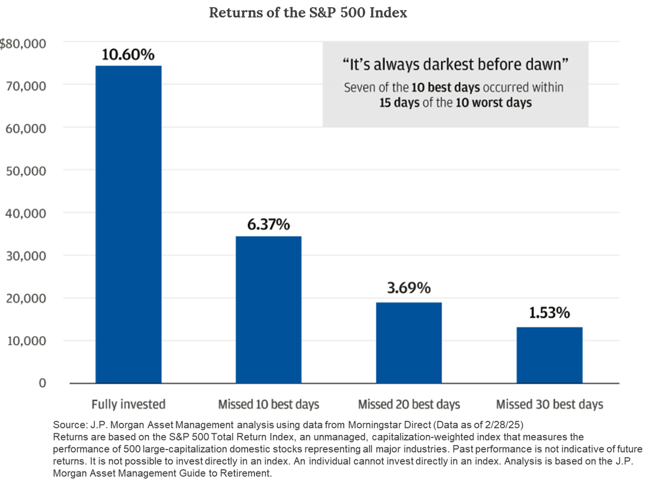
This behavioral reality has clear consequences for long-term compounding. When investors succumb to loss aversion, they interrupt the compounding process. Consider the chart below on the impact of missing the market’s best days. Seven of the 10 best days occurred within just two weeks of the 10 worst days. In 2020, for example, the sharp crash was immediately followed by the second-best day of the year. This makes timing the market not only impractical but counterproductive. Staying invested through drawdowns is paramount to long-term success.
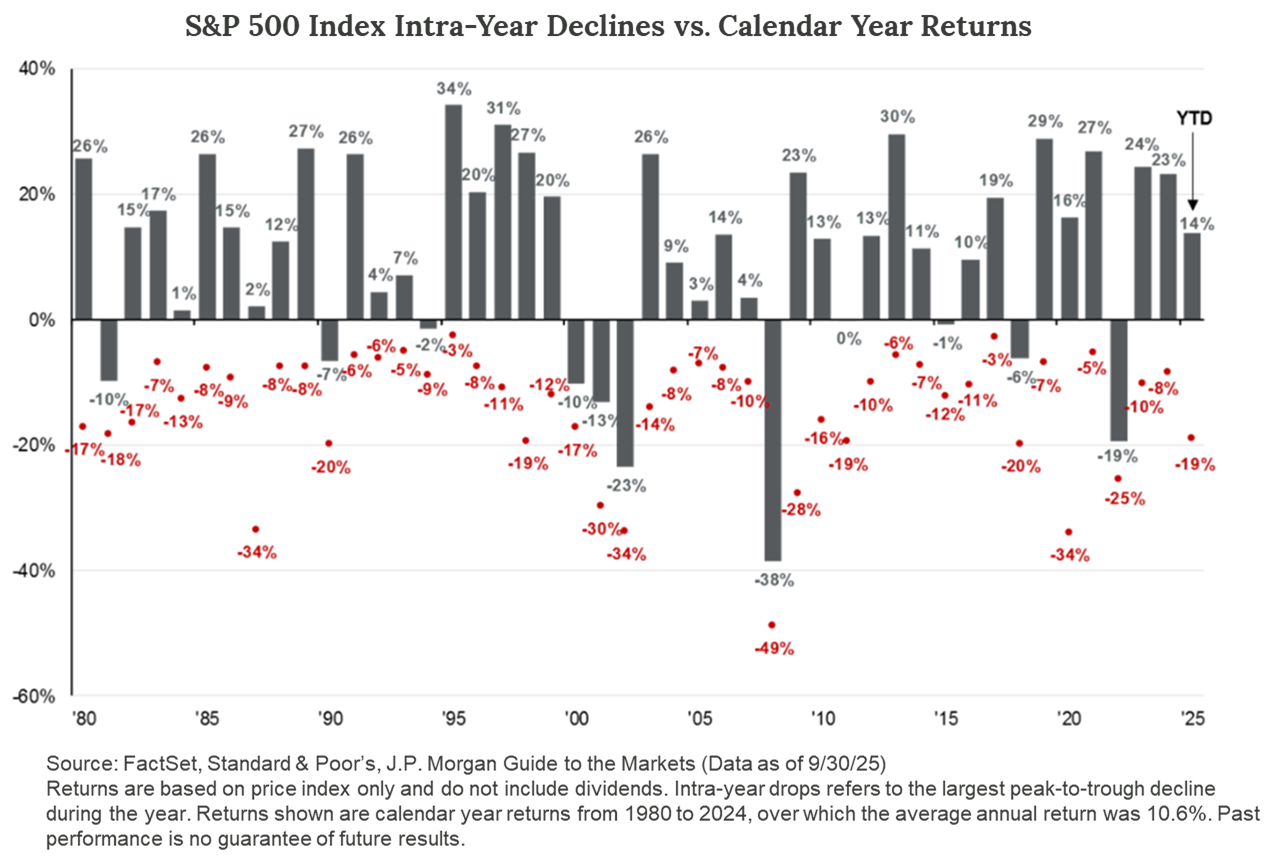
Of course, this is easier said than done. The next chart illustrates how severe intra-year declines can be, even when calendar-year returns finish in positive territory. Volatility is a regular feature of equity markets and enduring it requires resisting the urge to exit at precisely the wrong moment. Investors in the broad market must be willing to accept that turbulence is the cost of participation.
At Crawford, we take a different approach. While the S&P 500 serves as a useful barometer for market performance, our return streams look very different by design. We know that portfolios avoiding major drawdowns have a much higher probability of meeting long-term objectives, even if they forgo some of the market’s most speculative upside. We also recognize that when withdrawals are being made from a portfolio to fund spending needs, drawdowns are magnified and the required recovery becomes even steeper.
Limiting the damage of losses is not simply a matter of comfort; it is a critical driver of long-run outcomes. At Crawford, we believe in the merits of downside protection and the idea that a portfolio that reduces losses on the downside, even if it does not participate to the full extent of every market rally, can deliver competitive returns over a full market cycle. We seek to limit losses by investing in companies that can endure a variety of market environments. As a part of our due diligence process, we fully assess a business’s risk/return profile, and we emphasize high-quality companies with durable competitive advantages, strong balance sheets, and disciplined management teams. An added benefit of our approach is that during times of stress, investors often gravitate toward the high-quality, dividend-paying companies that comprise our portfolios, which can amplify our relative advantage.
Disclosures:
Crawford Investment Counsel, Inc (“Crawford”) is an investment adviser registered with the U.S. Securities and Exchange Commission. Registration does not imply a certain level of skill or training. More information about Crawford’s investment advisory services can be found in its Form ADV Part 2 and/or Form CRS, which is available upon request.
The opinions expressed are those of Crawford as of the date of publication and are subject to change without notice. Crawford reserves the right to modify its current investment strategies and techniques based on changing market dynamics or client needs. Past performance is not indicative of future results.
CRA-2511-3

Innovation & Transformation: Investing in AI
Given the pace of innovation and the rapid adoption of generative AI technologies, now is an exciting time to be an investor in companies with AI exposure. At Crawford, we can take advantage of these opportunities by identifying individual companies that both meet our quality requirements AND participate in these secular growth markets.

Origins: Crawford Dividend Growth Strategy
The old saying, “necessity is the motherhood of invention” is a good way of introducing the story of the origin of the Dividend Growth strategy.

Example of Investment Thesis: AstraZeneca
In the first installment of the Company Fundamental Investment Series, Senior Research Analyst and Director of Core Equity Strategy, Frank Pinkerton, walks us through an investments thesis.