
In today’s economy, we are digesting various signals. Some flash green, others yellow, and a few red. One area is the dichotomy between the Federal Reserve’s (Fed) actions and the bond market’s behavior.
On the surface, the Fed is acting within expectations of market participants. Inflation, although it remains above the 2% target, has moderated from its peak. Unemployment is growing as a concern, and policymakers have responded by lowering short-term interest rates. On paper, this is the playbook: ease financial conditions to support employment, relieve pressure on housing, and sustain economic momentum.
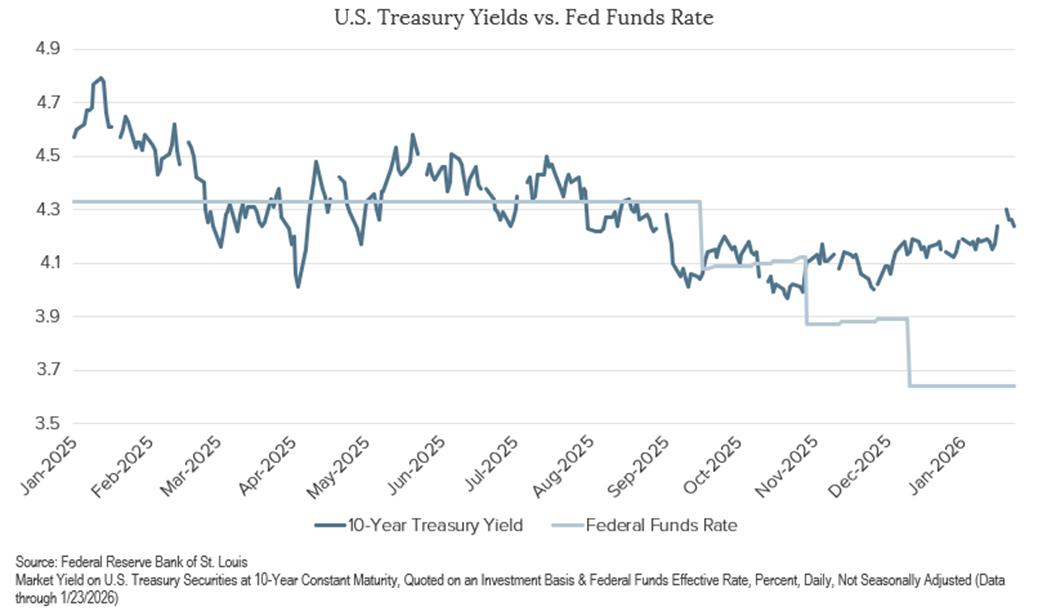
Yet, since September of 2024, when the Fed began reducing rates in the current cycle, 10-year Treasury yields are higher by over 60 basis points (0.6%). In other words, short-term rates are down, and long-term rates are up.
Diverging Rates: As a reminder, the Fed controls the overnight price of money. Every six to eight weeks, the Federal Open Market Committee, consisting of 12 members (7 board members and 5 regional bank presidents), votes on the Federal Funds rate, the rate at which banks lend to one another for very short periods. That rate ripples outward through the economy, influencing borrowing costs, asset prices, and economic activity. Lower rates encourage spending, borrowing, and investment; higher rates do the opposite.
The Fed’s influence on rates dissipates as timelines expand. 10-Year Treasury yields, mortgage rates, and other longer-term borrowing costs are more nuanced than a committee’s verdict. Instead, they are determined by investors’ collective expectations for inflation, growth, and risk over many years. Yet, most of the time, short-term and long-term interest rates move more or less in tandem. Despite the Fed’s pivot toward easing, the 10-year Treasury yield has remained stubbornly elevated. The current level is not historically high, but higher than many would prefer. The bond market, it seems, might be telling a different story than the traditional playbook.
What the Bond Market Is Saying: We have homed in on a couple of theories as to what is going on. First, bond investors may be expressing skepticism that inflation has been fully tamed. Even if near-term pressures have eased, the longer-term balance between growth, labor markets, and fiscal policy may still feel inflationary. If so, lower short-term rates today could ultimately mean higher rates again tomorrow.
Second, investors today may be demanding greater compensation for holding U.S. debt itself. Persistent deficits and an expanding supply of Treasuries are not necessarily new concerns, but prolonged worries almost always grow worse, especially when there is little confidence that things will change anytime soon. Higher yields may be the market’s way of lowering the price investors are willing to pay for seemingly “riskier” debt.
Third, there is the more subtle interpretation which encapsulates the prior two: uncertainty. When confidence in the long-term path of the economy weakens, investors often ask for a wider margin of safety. Sticky long-term rates can reflect not a single forecast, but a higher term premium, which could be a refusal to commit to any one benign outcome. In that sense, the bond market is not predicting disaster, and the interest rate backdrop remains conducive.
A Bifurcated Economy: This divergence mirrors a broader economic contradiction that was broached in a previous piece, The Economy vs. Itself. Here’s the summary: consumer sentiment remains subdued, affordability pressures persist, and headlines routinely warn of strain. Yet actual consumer spending continues to surprise to the upside, growing at a 3.5% annualized pace in the third quarter of 2025.
One plausible explanation is that the economy is being supported by a narrowing slice of consumers, those whose wealth has been amplified by rising asset prices and who are less sensitive to higher borrowing costs. If so, aggregate data can look healthy even as individuals’ experiences become more uneven. This is driven by the K-Shaped Economy. How long this economy can continue to work is not a question that markets, policymakers, or investors can answer with precision.
What This Means for Our Clients: The temptation in moments like this is to choose sides: to decide that either the Fed or the bond market must be “right.” Rather than try to predict the future course of economic or market events, we recognize that disagreement, in and of itself, is information. It tells us the range of plausible outcomes is fairly wide, and confidence is fragmented.
There are many different influences and opinions that make up the bond market. At Crawford, our bond portfolios are positioned to respond well to a variety of outcomes, including a continued soft landing or a cyclical downturn. Our strategies maintain a high-quality bias and are well-diversified with an above-average allocation to defensive sectors of fixed income markets. Maturities are spaced across the intermediate time horizon, which we believe will result in income maximization, preservation of capital, and potential performance upside as the cycle progresses.
This is precisely the environment where a consistent investment philosophy matters more than prediction. Rather than leveraging returns to a single rate path or economic outcome, we emphasize quality, prudence, valuation discipline, and resilience across scenarios. In sum, a total portfolio approach.
The economy, once again, is arguing with itself. Our job is not to pick a side, but to construct portfolios designed to narrow the range of investment outcomes, striving to deliver meaningful upside in rising markets and protection when conditions inevitably turn.
Disclosures:
Crawford Investment Counsel (“Crawford”) is an independent investment adviser registered under the Investment Advisers Act of 1940, as amended. Registration does not imply a certain level of skill or training. More information about Crawford, including our investment strategies, fees, and objectives, can be found in our Form ADV Part 2 and/or Form CRS, which is available upon request.
The opinions expressed are those of Crawford Investment Counsel as of the date of publication and subject to change without notice.
CRA-2601-27

The Year of Triple Tightening
We define triple tightening as the Fed raising interest rates, the Fed’s balance sheet shrinking, and reduction in fiscal programs to recipients.

The Uncertainty of Investment Returns
As a stock market investor, there are few guarantees. However, we believe if one has a well thought out discipline and remains invested, suitable results follow.

The State of Real Estate
Real estate prices and rents are top of mind these days. From the long-anticipated CRE problems to the resiliency of the housing market, there is much newsworthy material.