

Our article from earlier this year, Stocks: Rent or Own, pointed out that today the average holding period for any given stock is just six months. This timeframe is short-term in nature and more akin to renting an apartment as opposed to longer-term home ownership. This sort of trading mentality is speculative and not consistent with our investment philosophy at Crawford. So, we were surprised to see a recent article in the Wall Street Journal on September 12th which pointed out that many market participants today are not even renting, but instead opting for an even shorter-term, riskier trading vehicle. These are derivative instruments (options contracts) that expire in just a few days or even hours, and they have grown very popular, particularly with individual investors. If owning a stock with a six-month time horizon is analogous to renting, then these options contracts can be compared to staying in a hotel. Regardless, these investment vehicles represent pure speculation.
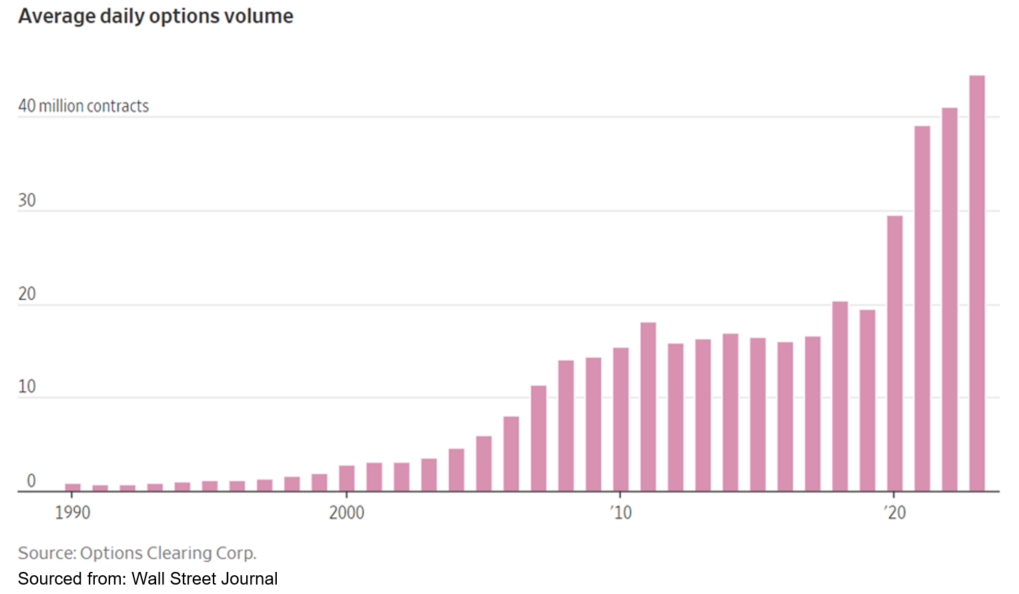
Options give individuals the right, though not the obligation, to buy or sell shares at a set price by a stated date. There is some debate, but since at least 30-35% of all options contracts expire worthless (return of -100%), the odds of success are pretty low. Investing in options is far more similar to gambling than investing, and the fact that these derivative instruments are being utilized by individual investors today indicates that greed is alive and well in the stock market. Generally, periods of speculative activity do not end well for the gamblers. As seen below, options volume has exploded over the past 30 years, especially as of late.
At Crawford, we are long-term investors, and our average holding period is between three and five years, depending on the specific investment strategy and the time period being measured. Turnover rates are not constant, and they are a function of the overall market, individual company valuations, the relative opportunity set, and often, volatility.
While changes in valuation may not necessarily have a primary impact on the return of a stock held for a longer period of time, most short-term traders rely on valuation changes driven by investor sentiment and short-term developments to sustain their livelihoods. This is a significantly more risky and unpredictable way to invest, and it does not dovetail with the objectives of most individuals. Additionally, due to capital gains taxes and transaction costs, longer-term approaches offer individuals significant tax advantages compared to shorter-term strategies. Commissions may be “zero,” but there are also frictional trading costs, which can add up and make a difference over time.
At Crawford, our approach is to own businesses. The stock market affords us liquidity, which enables the ability to achieve diversification, exit positions that may have experienced fundamental deterioration or overvaluation, and satisfy client needs for funds to be withdrawn. The businesses in which we invest also pay dividends, providing cash flow to owners. We do not think the “American Dream” has ever been about renting a home or staying in a hotel. Instead, it was built on ownership. This certainly applies to our investment approach, which seems to be running counter to the actions of many more aggressive traders today. In this case, we prefer to not follow the herd, but instead will follow longer-term business fundamentals, seeking out dividend yield, growth, and valuation improvement. We believe the outlook is bright for long-term owners of high-quality businesses.
Disclosures:
Crawford Investment Counsel (“Crawford”) is an independent investment adviser registered under the Investment Advisers Act of 1940, as amended. Registration does not imply a certain level of skill or training. More information about Crawford, including our investment strategies, fees, and objectives, can be found in our Form ADV Part 2and/or Form CRS, which is available upon request.
The opinions expressed are those of Crawford. The opinions referenced are as of the date of the commentary and are subject to change, without notice, due to changes in the market or economic conditions and may not necessarily come to pass. There is no guarantee of the future performance of any Crawford portfolio. Crawford reserves the right to modify its current investment strategies and techniques based on changing market dynamics or client needs.
Material presented has been derived from sources considered to be reliable, but the accuracy and completeness cannot be guaranteed.
CRA-23-167

Stock Rating System
We utilize a formal, subjective stock rating system to communicate how we are evaluating individual investment opportunities.

The Corporate Juggernaut: Can It Be Stopped?
Many observers of the stock market seem to be amazed at how well common stocks have done over recent years.

It All Started with a Can of Beans
Here is a story of how an investor got his start and how it led to a love of investing that lasted a lifetime.