

Research from Hendrik Bessembinder of Arizona State University has found that the best-performing 4% of listed companies accounted for the net gain of the entire U.S. stock market since 1926, while the remaining 96% collectively matched the return of one-month Treasury bills. This is a striking comparison because Treasury bills are generally considered risk-free, while stock market investing requires investors to assume meaningful risk. The study is often discussed as evidence that only a small number of companies drive overall stock market returns. This causes many investors to focus on uncovering the next big winners, and it often leads to money-losing investments.
We previously explored Bessembinder’s research and the way it relates to our investment philosophy in this piece. Here, we choose to focus on the other side of the research: the evidence that a much larger group of companies fail to create lasting shareholder value at all. In fact, Bessembinder’s updated research found that the median buy-and-hold return for U.S. common stocks over the past century was negative, and nearly 60% of stocks reduced shareholder wealth over their full public lives. This means that long-term investing is not only about identifying upside, but it is also about avoiding permanent impairment of capital. Both displays below help illustrate how narrow long-term wealth creation has been across the stock market, and how large the portion of the market is that failed to outperform even one-month Treasury bills.
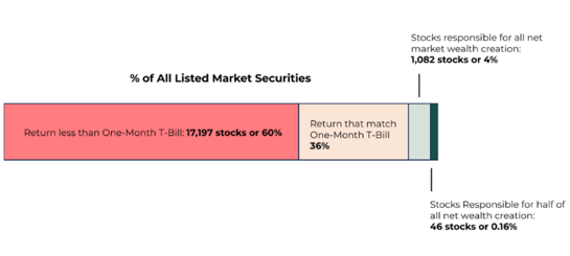 Source: Hendrik Bessembinder, updated research on wealth creation in U.S. public equities (data updated through 12/31/2025).
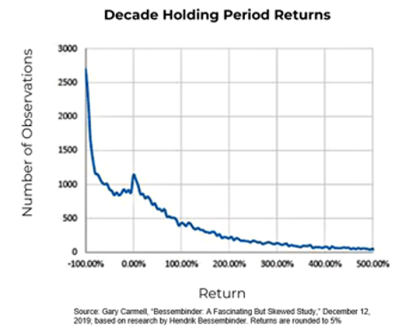
Many of the companies that ultimately destroy shareholder value begin their public lives tied to powerful themes, and it turns out most of the biggest losers have this in common. They were described, at one point or another, as the next great growth company, the next category leader, or the next beneficiary of a transformative technology. When a powerful theme captures investor attention and raises large amounts of capital, the market often extrapolates success far into the future. The more compelling the story, the easier it becomes for investors to overlook business quality, balance sheet risk, profitability, or the price being paid. Share prices of these companies, when they end up declining, go down to such a great extent because expectations exceeded economic reality.
At Crawford, we are not seeking to identify the companies that might become one of the market’s extraordinary winners. Instead, we believe there is a narrow and attractive part of the market where durable businesses can persevere, profit, and compound value over long periods of time. These businesses do not necessarily reside on the far right-hand side of the return distribution, but they possess characteristics that improve the odds of positive long-term outcomes for shareholders. These characteristics include durable competitive positions, recurring demand, strong balance sheets, consistent cash flow generation, disciplined capital allocation, and a demonstrated commitment to shareholders.
Our approach does not guarantee ownership of only those companies that ultimately create wealth. But by avoiding chasing the hot stocks, we avoid many losers. In fact, many of the market’s greatest long-term winners pass through periods when their valuations, business models, or capital needs make them difficult to underwrite through the lens of quality and valuation discipline. We accept this reality because our objective is not to own every winner, but rather to build portfolios of companies that have a high probability of producing positive long-term outcomes for shareholders. That means focusing on businesses that can survive changing economic conditions, fund their own growth, defend profitability, and return cash to shareholders over time. It also means investing in companies when expectations are modest. However, we would also point out that, over our firm’s history, we have owned a meaningful number of the relatively few businesses that Bessembinder’s study cites as the most significant drivers of market wealth creation.
This is especially relevant today. Artificial intelligence is a powerful and transformative trend, but many companies are being presented as future winners before the economic outcomes are fully known. Some will undoubtedly benefit, while others may fail to convert elevated expectations into durable shareholder value. As always, the challenge is not simply identifying companies with exposure to a compelling theme, but determining which businesses can translate that exposure into sustainable earnings, cash flow, and returns on capital.
Over time, we believe the quality attributes of the businesses we invest in greatly improve the odds of remaining on the right side of the market’s return distribution. Valuation sensitivity matters as well. We may not always capture the full extent of the upside from the most speculative areas of the market, but we believe our discipline can enable clients to participate in the long-term benefits of equity ownership without all of the risk. That is, our methodology mitigates the likelihood of permanent losses that define the market’s left-hand tail, where most of the stock universe ultimately resides.
Disclosures:
Crawford Investment Counsel Inc. (“Crawford”) is an investment adviser registered with the U.S. Securities and Exchange Commission. Registration does not imply a certain level of skill or training. More information about Crawford’s investment advisory services can be found in our ADV Part 2 and/or Form CRS, which is available upon request. Additional information can be found at www.crawfordinvestment.com.
The opinions expressed are those of Crawford Investment Council Inc. (“Crawford”). The opinions referenced are as of the date of publication and are subject to change due to changes in the market or economic conditions and may not necessarily come to pass. Forward-looking statements cannot be guaranteed.
CRA-2604-45

Are Bond Yields Compensating Investors for Inflation
Bourgeoning inflation anxiety has many bond investors concerned about being adequately compensated.

Investing in Energy Infrastructure
Have you ever thought about how the natural gas we use for cooking or to heat our homes gets there?

Investing in a Recession
A quick review of history reveals that the U.S. economy experiences a recession, on average, about every five to six years.