
Dividends serve two separate but related purposes at Crawford. First, we use the dividend and dividend history as a quality indicator, which is a key tenet of our philosophy. We have long believed that dividends are more than simply a return of capital because they can also be an important indicator of a company’s financial strength, a reflection of sound capital allocation discipline, and evidence of alignment with and commitment to shareholders. In addition, dividends generate spendable income and a reliable source of return through consistent cash flows that, in many cases, are rising. It also cannot be overlooked that dividends and the income component of stock market returns have historically represented a meaningful portion of total shareholder results. We therefore have many reasons to favor dividends.
Our Dividend Yield strategy is built around these principles and, we believe, accentuates the positive aspects of dividends by focusing on businesses at the intersection of high quality and high yield. The objective of the strategy is to provide total investment return (income plus appreciation), but a priority is to maintain a high level of current yield (income) coupled with income growth. Historically, the yield on the strategy has been around or above 4%. The strategy’s value orientation means we are purchasing reasonably priced stocks, while the consistency and quality of the companies support dividend safety and, ultimately, fundamental improvement. It is the combination of fundamental improvement and valuation expansion that leads to capital appreciation and, when combined with the dividend yield, this leads to long-term compounding. It is designed to address the broader needs of income-oriented investors through a combination of quality, value, active management, and risk control. Below, we provide additional detail on our investment process.
We like to call it the 4% solution, but the strategy is about more than its starting yield. A high dividend yield can be attractive, but yield alone does not make an investment compelling. In some cases, an unusually high yield reflects financial distress, deteriorating fundamentals, or a dividend that may not be sustainable. For this reason, we do not simply purchase the highest-yielding securities available and avoid “yield-traps.” We do this by seeking investment opportunities that lie at the intersection of elevated yield, high quality, and attractive valuation. Our research has historically led us most often to companies in the eighth and ninth dividend-yield deciles, meaning the income is high but below the highest level (tenth decile). We have found that these businesses are generally higher quality and can provide meaningfully above-average income while mitigating the risk of a dividend reduction.
Our in-house research team conducts fundamental, bottom-up research focused on business models, industry positions, profitability, balance sheets, cash flow generation, and capital allocation history. We also evaluate management incentives, corporate governance, and each company’s ability and willingness to sustain its dividend through a range of economic conditions. The objective is to determine whether the company can support its dividend over time and whether the stock offers an attractive total return opportunity at the price we are investing. In summary, we are looking for quality and value.
The Dividend Yield portfolio is not static nor does it passively collect dividends. We actively reallocate capital as valuations, fundamentals, and dividend yields change. Many of our most attractive opportunities arise when a high-quality company is experiencing a temporary price dislocation (decline). The disruption may result from a short-term business issue, disappointing near-term results, or a decline in investor sentiment. When the stock price falls, the dividend yield rises. Our longer time horizon and fundamental, bottom-up research process allow us to evaluate whether the problem is temporary or whether the company’s long-term prospects have genuinely deteriorated. When we believe the business remains fundamentally sound and see a credible path toward improvement, we look to purchase the stock at an elevated yield.
By investing in this manner, our clients are essentially being paid to wait. While the company works through the issue, the portfolio collects an above-average stream of income. If the business progresses as expected and investor confidence begins to recover, the stock’s valuation will likely normalize. As this occurs, the share price rises, the dividend yield falls, and the portfolio benefits from both the income received and the capital appreciation generated along the way. Often, dividend increases help maintain a high level of yield even as the share price appreciates.
When the yield falls below an acceptable level for the strategy, we may sell the position and redeploy the appreciated capital into another high-quality company offering a more attractive yield. This recycling of capital is an important way the strategy achieves growth of income, in addition to the regular dividend increases provided by the high-quality companies we own. For investors, this provides an income stream that is not only well above-average, but that also should exceed the growth rate of inflation.
Our approach is value-oriented by nature. We are looking for durable businesses whose stock prices do not fully reflect their long-term earnings power, asset value, or ability to generate cash flow. This valuation discipline contributes to return potential and helps us manage risk. The Dividend Yield Strategy tends to own more mature, less cyclical businesses with demonstrated cash flow and a willingness to return capital to shareholders. These companies are often less dependent on high growth assumptions or favorable market conditions to support their valuations.
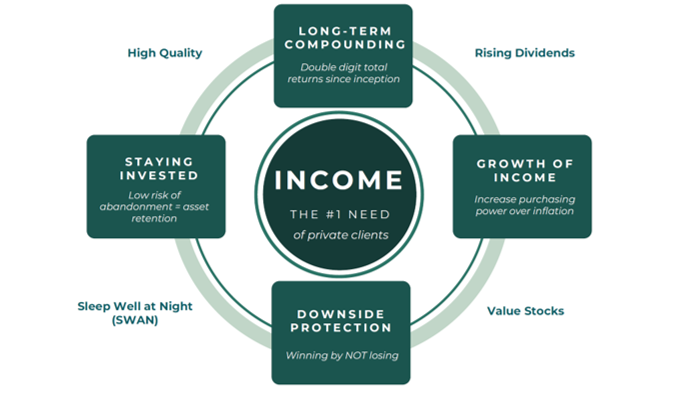
An added benefit of our process has been a lower-volatility investment experience relative to the broader equity market and the strategy’s primary benchmark. The portfolio’s income, quality, and valuation discipline can provide support during difficult markets. Downside protection has value beyond the losses it may help mitigate. Severe losses and excessive volatility disrupt compounding. Even worse, the uncertainty can cause investors to abandon a sound long-term plan at precisely the wrong time. We view abandonment as an unacceptable outcome because the portfolio no longer has the opportunity to participate in the eventual recovery or benefit from the continued reinvestment of income. The combination of income, growth of income, total investment return and downside resilience increases the likelihood that investors remain committed through a full market cycle. This is the essence of the “Sleep Well At Night” outcome shown in the accompanying display.
The “Sleep Well at Night” component is further bolstered by the fact that the portfolio owns recognizable companies that are blue-chip in nature. These companies tend to have low capital requirements, leaving ample free cash flow to return to shareholders. The investment horizon is longer term, so portfolio turnover is not excessive. In addition, the income generation provides a source of comfort as generating current income has long been a priority among individual investors. All of this works together to help clients feel comfortable with the investment allocation being implemented on their behalf.
Each element of the Dividend Yield strategy is intended to support the next. High-quality companies provide the financial foundation for sustainable dividends. Attractive valuations create the potential for capital appreciation and reduce dependence on excessive expectations. Rising dividends and active capital reallocation support income growth. Income growth helps protect purchasing power and builds up the yield on cost. Downside resilience makes it easier for investors to stay invested, which allows the assets to compound. The 4% yield may be the starting point, but the broader objective is to convert that income into growing purchasing power, a more resilient investment experience, and durable long-term wealth.
Disclosures:
Crawford Investment Counsel Inc. (“Crawford”) is an investment adviser registered with the U.S. Securities and Exchange Commission. Registration does not imply a certain level of skill or training. More information about Crawford’s investment advisory services can be found in our ADV Part 2 and/or Form CRS, which is available upon request. The opinions expressed are those of Crawford Investment Counsel as of the date of publication and are subject to change due to changes in the market or economic conditions and may not necessarily come to pass. Forward-looking statements cannot be guaranteed. Past performance is not indicative of future results. There is no guarantee of the future performance of any Crawford portfolio. All investments involve risk, including loss of principal, and there is no guarantee that investment objectives will be met. CRA-2608-2

Origins: Crawford Dividend Growth Strategy
The old saying, “necessity is the motherhood of invention” is a good way of introducing the story of the origin of the Dividend Growth strategy.
Stocks: Rent, Own, or Just Stay in a Hotel?
If owning a stock with a six-month time horizon is analogous to renting, then options contracts can be compared to staying in a hotel.

Terrible Economy Surging Stock Market
The last four months have presented investors with a situation unlike any other in the history of the U.S. economy and stock market