In this piece, we take key points from our firm's most recent Bond Policy Meeting and share them with our readers. Hopefully, this piece will provide some insight into the economy and fixed income markets and give you a sense of how our team is thinking about recent trends and developments.
Crawford Bond Policy
- We believe performance this year is likely to be driven by yield/income and securities rolling down the curve (resetting to shorter benchmarks). Consequently, we are focused on positioning for yield maximization and rolldown characteristics versus market risk (extending duration).
- Confidence in the U.S. economy’s ability to weather the inflation uncertainty has grown as evidenced by the performance of risk assets.
- Normally, a perceived reversal in Fed policy direction toward tightening based on a need to quell inflation would be viewed as negative for economic growth potential.
- However, recent job market, spending, and sentiment data suggest the economy is on very solid ground and has the strength to endure an increase in interest rates without falling into recession.
- There is a certain numbness to recession risk having survived a rapid Fed tightening cycle, inverted yield curve, banking crisis, and tariffs.
- The keys to continued economic success despite the potential for tighter monetary policy lie in continued labor market strength, AI optimism, capital spend, and consumer confidence.
Treasury Market
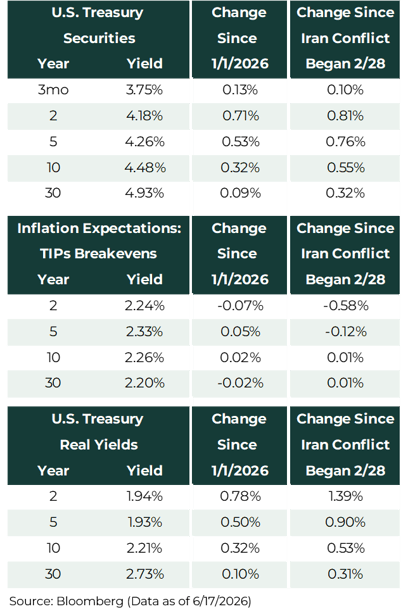
- U.S. Treasury yields are higher year-to-date driven primarily by the energy supply shock resulting from the war in Iran.
-
Treasury yields on the 30-year Bond, and 10-year Note reached recent highs of 5.19% and 4.68%, respectively.
-
Since the war began at the end of February, yields have stayed highly correlated to oil prices.
-
The potential knock-on inflationary effects of those prices staying elevated for an extended period has pushed up market expectations for Fed rate hikes and is illustrated by the increase in Real Yields across the curve.
-
The Fed Funds futures market currently has a full 25 basis point rate increase priced-in to the October Fed meeting.
- The MOVE index, pictured below, which measures how much the market expects yields to move in the future (as opposed to how much they have moved in the past) has settled at a higher-than pre-war level but further demonstrates the relationship between oil prices and yields.

Investment Grade Corporate Bond Market
- Investment grade corporate bond spreads (yield compensation for credit risk) are back to being consistently compressed after a brief period of widening brought about by concerns over the Iran conflict.
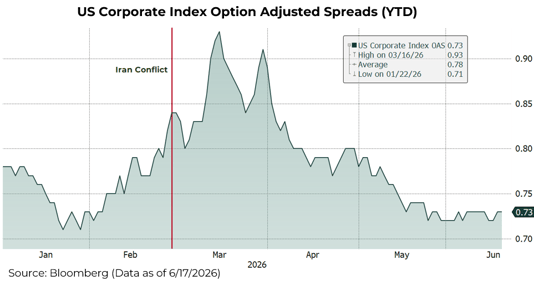
- This tightness is being experienced despite record new issue supply.
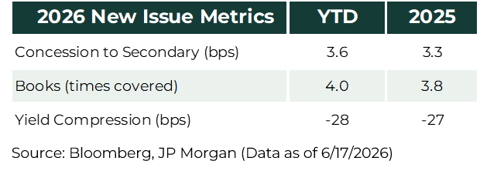
- Hyperscalers have accounted for over 20% of non-financial issuance. Demand has remained strong, as exhibited by the following new issue metrics:
- Retail investor demand has remained strong. This is largely being supported by the attraction of elevated nominal yields.
Municipal Bond Market
- Yields increased across the “AAA” Municipal Scale since the beginning of the Iran conflict, but year-to-date movement is less dramatic due to the significant decline in yields leading up to the war.

- Demand has played the most significant role in driving municipal bond performance this year.
- This demand is being driven by elevated taxable-equivalent yields and positive total return performance, and it has overwhelmed the influence of heavy new issue supply.
- Quality in the high-grade municipal sector remains high, on average, with States maintaining all-time high rainy day fund balances.
- State revenues are projected to climb for a fifth straight year but spending demands are increasing, as well, driven by healthcare, housing, and education needs.
DOT Plot and Summary of Economic Projections (SEP)
- GDP and Unemployment Rate expectations dropped modestly for 2026 but remained steady for the next 2 years and long-run.
- Inflation forecasts were revised significantly higher for 2026, but headline inflation in 2027 was only projected to be modestly higher than the March estimate. This suggests the energy-driven impact on prices is expected to be transitory.
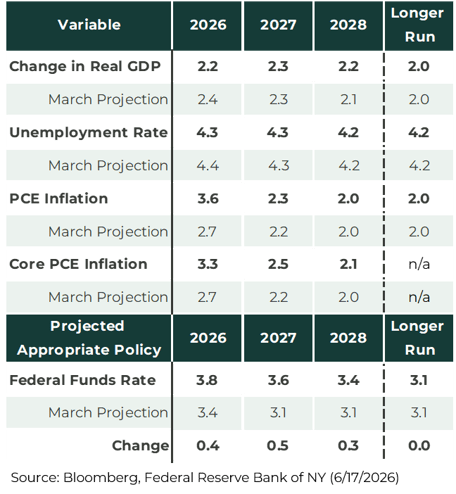
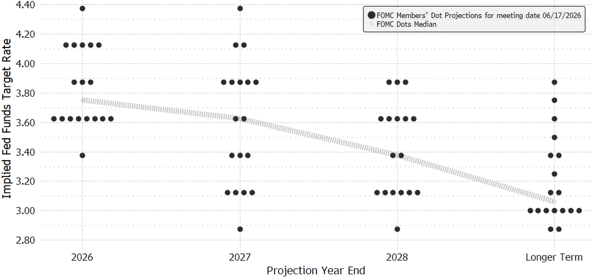
- Median expectations for the target rate are higher across the 2026 - 2028 spectrum, and do not indicate a reduction from the current target range until 2028.
- Only 18 officials are represented in the SEP/DOT Plot as Chairman Warsh did not submit a projection for any year and 1 member withheld a 2028 forecast.
- The DOT Plot shows 9 participants anticipate at 1 rate hike by the end of the year with 6 of those expecting 2 hikes. The median participant at the March meeting expected 1 cut this year.
Disclosures
Crawford Investment Counsel (“Crawford”) is an independent investment adviser registered under the Investment Advisers Act of 1940, as amended. Registration does not imply a certain level of skill or training. More information about Crawford, including our investment strategies, fees, and objectives, can be found in our Form ADV Part 2and/or Form CRS, which is available upon request.
The opinions expressed are those of Crawford. The opinions referenced are as of the date of the commentary and are subject to change, without notice, due to changes in the market or economic conditions and may not necessarily come to pass. There is no guarantee of the future performance of any Crawford portfolio. Crawford reserves the right to modify its current investment strategies and techniques based on changing market dynamics or client needs.
Material presented has been derived from sources considered to be reliable, but the accuracy and completeness cannot be guaranteed. CRA-2606-2

Crawford Bond Policy Update
Crawford's bond policy reflects the firm's stance on the fixed income markets, interest rates, inflation, and more.

September Bond Policy Update
Crawford's bond policy reflects the firm's stance on the fixed income markets, interest rates, inflation, and more.

November Bond Policy Update
Crawford's bond policy reflects the firm's stance on the fixed income markets, interest rates, inflation, and more.