
At Crawford Investment Counsel, we have long recognized that dividends are more than just a return of capital, they are a key indicator of a company’s financial strength, discipline, and long-term commitment to shareholders. They also make up a significant component of total shareholder return over the long term. Our investment philosophy is rooted in the belief that high-quality, dividend-paying companies offer compelling opportunities for investors to achieve the dual objectives of income generation and capital appreciation. Two of our equity strategies, Dividend Growth and Dividend Yield, both embrace this principle but apply it in distinct ways. Although the portfolio construction methodology and objectives are differentiated, both strategies have an above-average dividend yield, offer rising income, and produce what we believe is attractive total return with downside protection.
Our Dividend Growth strategy invests in companies that have a proven track record of at least 10 years of consistent dividend payments, demonstrate resilient cash flows and strong balance sheets, and exhibit pricing power and sustainable business models that support long-term growth. Our investment process is rooted in our belief that dividend increases add up over time, compounding under the surface to the shareholder’s benefit. We believe dividend growth is one of the factors that gradually pushes the price of a stock upward and supports it in periods of economic stress. Investing in companies of this nature brings various other benefits, particularly those related to risk management.
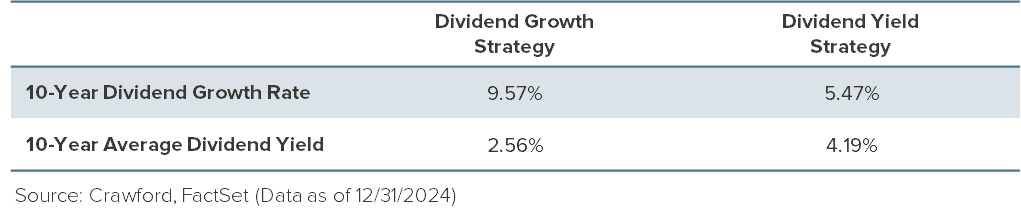
This strategy is ideal for investors who prioritize a rising income stream over time, seek capital appreciation alongside growing dividends, and are focused on long-term asset accumulation with low volatility and inflation protection. In our Dividend Growth strategy, growth of income is primarily achieved by the actual growing dividends distributed by the businesses we invest in, as evidenced by the strategy’s high 10-year dividend growth rate represented in the table above.
While dividend growth focuses on the expansion of income, our Dividend Yield Strategy prioritizes a high level of current income. The goal is to maintain an elevated portfolio yield by owning higher-yielding equities dynamically reallocating capital to attractive opportunities. In other words, we purchase companies with elevated and rising dividend yields, and often, the dividend yield is high because the stock is experiencing a temporary price dislocation. This can be a result of a short-term business issue or temporary decline in investor sentiment. Our fundamental, bottom-up research process and longer time horizon aim to give us an edge and enable us to identify and invest in these out-of-favor but high-quality stocks with a catalyst for reversion to the mean in valuation. These are investment opportunities that many investors overlook, ignore, or eschew due to shorter-term performance pressures and more myopic investment strategies. We are happy to collect an above-average yield while we patiently await the reversion to the mean. As valuation starts to normalize, the price increases and yield typically decreases, offering us the opportunity to recycle the capital into another higher-yielding investment opportunity.
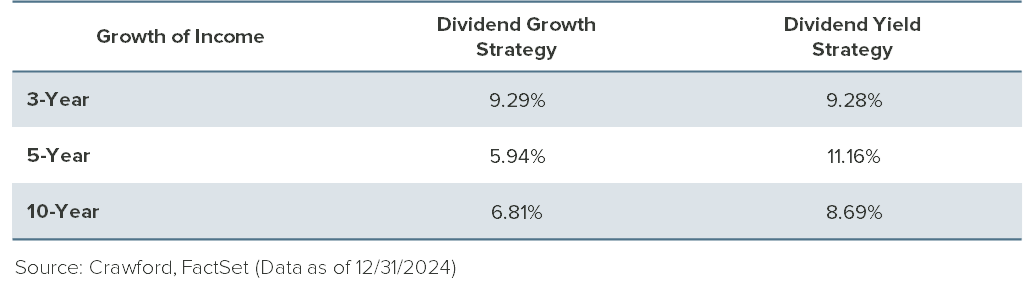
The level of income growth we have achieved in this strategy is high because we are effectively purchasing companies with elevated dividend yields, waiting for the fundamental improvement that we write into our investment theses, and selling the companies when the yields fall below an acceptable level for the strategy. The good news is that as the yield falls, it is due to the price of the stock increasing, contributing to total investment return in the process. While our Dividend Yield strategy has a slower dividend growth rate than our other strategies that focus on investing in companies with consistent dividend growth, it actually has a higher income growth rate due to the active management process described above.
We believe this strategy is ideal for investors who require higher current income for cash flow needs, seek to capitalize on mispriced opportunities in dividend stocks, and want to maintain a portfolio with an above-market yield. By focusing on high-yielding stocks that are undervalued but fundamentally strong, we construct a portfolio that provides consistently high income while still preserving our longstanding commitment to quality.
At Crawford, we believe the best investment opportunities arise when we exploit inefficiencies while staying true to our quality-oriented philosophy. Our Dividend Growth and Dividend Yield strategies offer two distinct paths to harness the power of dividends, allowing investors to align their portfolios with their specific income and return objectives. Regardless of the approach, dividends remain at the heart of our investment philosophy, and we will continue to invest according to this long held philosophy to the benefit of our investors.
Disclosures:
Crawford Investment Counsel (“Crawford”) is an independent investment adviser registered under the Investment Advisers Act of 1940, as amended. Registration does not imply a certain level of skill or training. More information about Crawford, including our investment strategies, fees, and objectives, can be found in our Form ADV Part 2 and/or Form CRS, which is available upon request.
The opinions expressed are those of Crawford. The opinions referenced are as of the date of the commentary and are subject to change. Crawford reserves the right to modify its current investment strategies and techniques based on changing market dynamics or client needs.
Material presented has been derived from sources considered to be reliable, but the accuracy and completeness cannot be guaranteed. Past performance is no guarantee of future results. Forward-looking statements cannot be guaranteed.
CRA-2503-2

Don't Be Fooled By Dividend Hubris
Not all dividend-payers possess Dividend Integrity, and some actually exhibit what we call Dividend Hubris.

What is a Preferred Stock?
Preferred stocks are equity securities that are required to pay interest or dividends before common dividends are paid to common stockholders.

The Role of Stocks & Bonds in a Balanced Portfolio
Owning a portfolio of companies that regularly increase their earnings and dividends is a powerful force.