

At Crawford, we believe that our SMID Cap strategy is a compelling investment opportunity for long-term investors. While large caps dominate headlines today and small caps offer high growth potential with higher risk, the small-to-mid cap space has numerous investment opportunities that lie at the intersection of quality, value, and investor neglect. These all come together to provide a robust opportunity set of attractive investment candidates. By focusing on dividend payers, quality, and value, the Crawford SMID Cap strategy can capitalize on both long-standing behavioral biases and stock market inefficiencies. This in turn enables us to provide attractive risk-adjusted returns through disciplined stock selection and portfolio construction. In today's environment, where small-to-mid cap stocks are undervalued relative to their large cap counterparts, we believe this approach is more relevant and timely than ever.
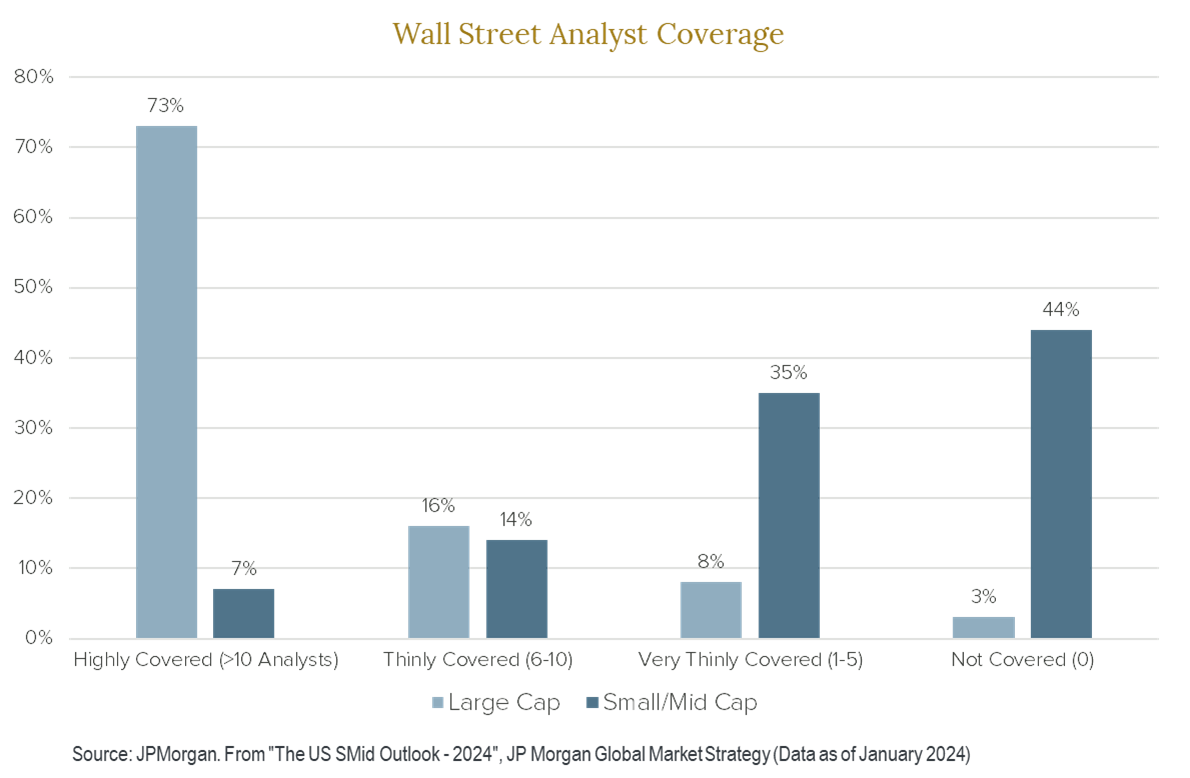
One of the greatest opportunities in small-to-mid cap investing rests in the relative inefficiency of this area of the market. Large cap stocks are heavily scrutinized by analysts, while small-to-mid cap stocks often fly under the radar with less analyst coverage, which correlates to more frequent mispricings, valuation dislocations, and ultimately, opportunities to earn outsized investment returns. We believe disciplined and informed investors can exploit these pricing inefficiencies to the benefit of our investors. We gain an information advantage through our in-depth, fundamental, bottom-up research process conducted by our well-tenured team of equity research analysts. The lack of analyst coverage illustrated below can provide long-term investors like us with a competitive advantage.
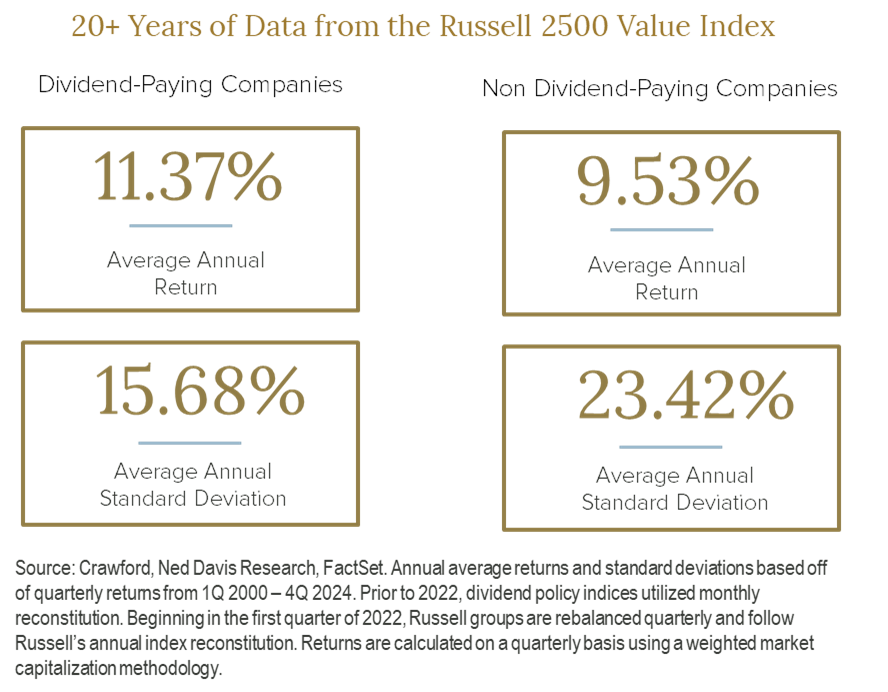
In addition to the information advantage, there is a persistent and structural bias against higher-quality smaller capitalization companies that creates a quality premium in smaller capitalization stocks. The quality premium means that investors in higher-quality smaller capitalization stocks can earn a superior return as compared to lower-quality smaller company stocks. This is one of the biggest anomalies in investing we have encountered in our firm’s 44-year history. The average annual return and standard deviation statistics below indicate that higher-quality companies, as evidenced by their dividend-paying status, frequently outperform non-dividend-paying, lower-quality companies in the Russell 2500 Value Index, the benchmark for our SMID Cap strategy. Importantly, they outperform with lower risk.
Why does this quality premium exist? Many investors approach small-to-mid caps with a “swing-for-the-fences” mentality, chasing deep value or speculative growth stocks with unproven businesses and unstable financials. They come to this space with a high risk, high reward mindset, targeting companies with potential for outsized return. However, many of these companies have compromised balance sheets, outdated or unproven business models, and require a favorable external environment (like low interest rates) to perform well. These characteristics can ultimately lead to a much wider range of outcomes than what investors might be betting on. This creates an investor bias against higher-quality, more stable, dividend-paying smaller capitalization companies. This behavioral bias means quality is frequently underpriced in the small-to-mid cap area of the market. In addition to the attractive valuation opportunity, dividend paying small-to-mid cap stocks have various favorable characteristics including greater financial discipline, more stable earnings, and a lower risk of distress. We believe that these quality characteristics are particularly important when investing in smaller capitalization companies, as they provide important downside protection benefits in a typically more volatile market segment. We believe these are a few of the factors that lead to the quality premium.
The combination of an information advantage and quality premium have led to superior returns and lower risk for the Crawford SMID Cap strategy when compared to the Russell 2500 Value Index.
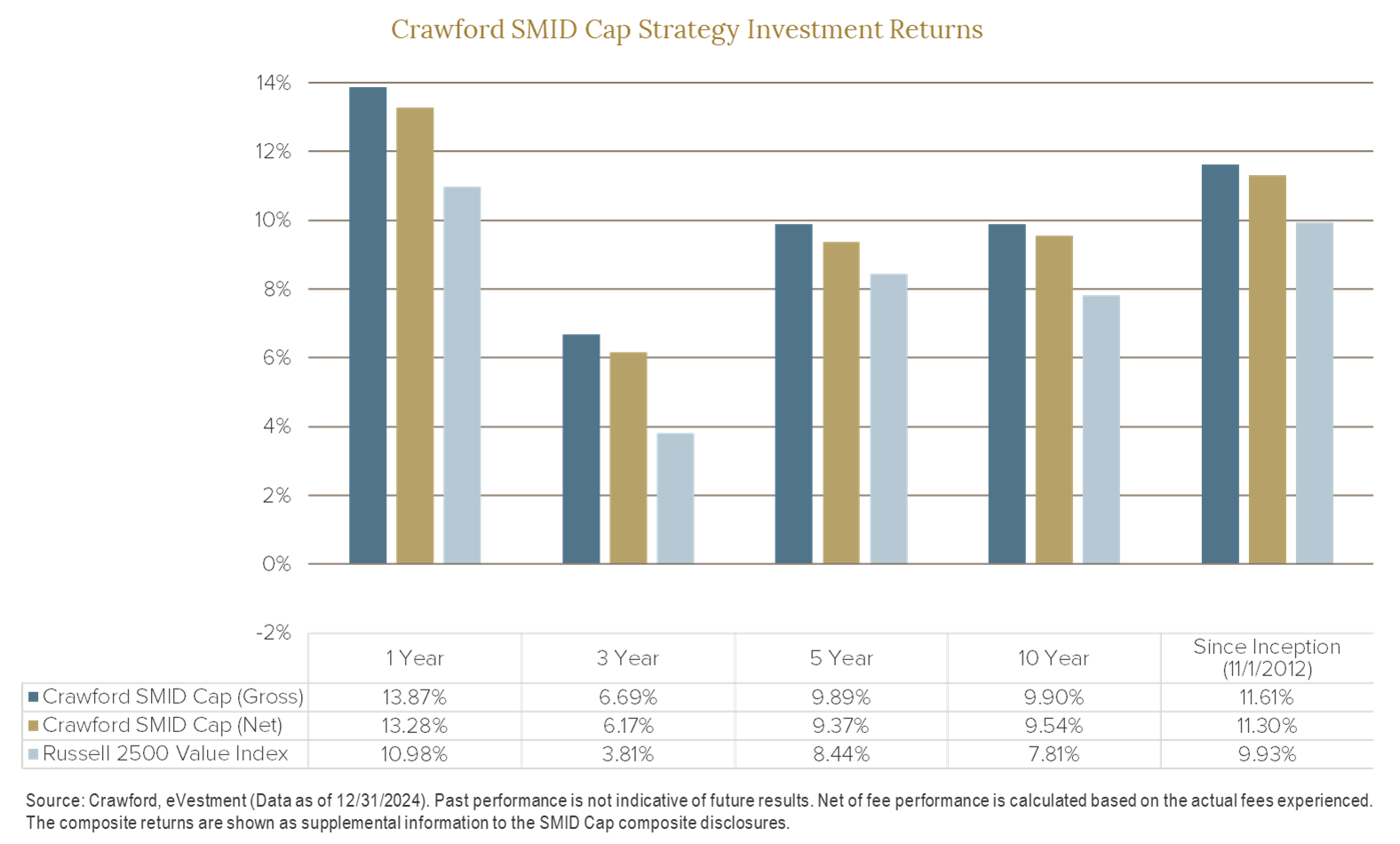
Intuitively, small-to-mid cap stocks are attractive because they are somewhere between the higher-risk, higher potential reward nature of small caps and the stability of large caps. With an information advantage and behavioral biases in this space, Crawford is able to offer investors an attractive way to participate in this area of the market and enjoy a compelling degree of growth potential without all of the risk associated with lower-quality small cap investing. We believe quality is underappreciated by investors, especially in the small-to-mid cap area.
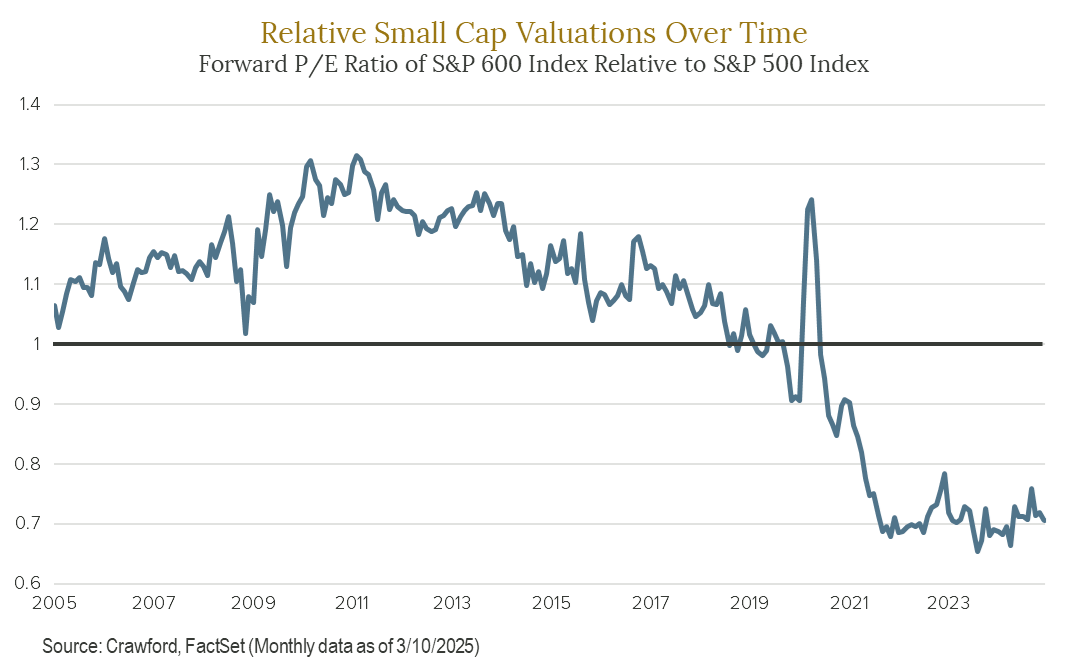
Our SMID Cap strategy is built to capitalize on market inefficiencies while avoiding the pitfalls of excessive speculation. We identify opportunities in overlooked but fundamentally strong businesses that have demonstrated durability, profitability, and financial discipline but remain mispriced by the market. Not to mention, the valuation gap between small-to-mid cap stocks and large caps is wider than historical averages today, creating an attractive entry point. Large caps have recently demonstrated dramatic outperformance over small and mid caps, and we do not believe this outperformance is sustainable. In turn, we believe a reversion to the mean is likely. We believe this should result in outperformance of small-to-mid cap stocks, hence strong performance, at least on a relative basis, for the Crawford SMID Cap strategy moving forward.
Please reference our related Perspectives post for more detail:
Disclosures:
To view a copy of the SMID Cap composite disclosure, visit the following link: https://info.crawfordinvestment.com/hubfs/Crawford_SMID_Cap_Composite_Report.pdf
Crawford Investment Counsel (“Crawford”) is an independent investment adviser registered under the Investment Advisers Act of 1940, as amended. Registration does not imply a certain level of skill or training. More information about Crawford, including our investment strategies, fees, and objectives, can be found in our Form ADV Part 2 and/or Form CRS, which is available upon request.
The opinions expressed are those of Crawford. The opinions referenced are as of the date of the commentary and are subject to change. Crawford reserves the right to modify its current investment strategies and techniques based on changing market dynamics or client needs.
Material presented has been derived from sources considered to be reliable, but the accuracy and completeness cannot be guaranteed. Past performance is no guarantee of future results. Forward-looking statements cannot be guaranteed.
CRA-2503-1

Income and Capital Preservation: An Investor Case Study
Since 2014, the Crawford Managed Income Strategy has offered its investors protection against both principal erosion and permanent loss of capital.

Small Cap Research Process
(CIC) Small Cap strategy aims to deliver attractive investment returns over the long run while reducing the volatility..

Benefit of Working with CIC - Preservation of Capital
We consider preservation of capital to be a primary investment objective of any portfolio.