
At Crawford, we have a common sense retirement planning solution that focuses on portfolio income and utilizes a proprietary liquidity bucket approach. This dovetails with our long-held investment philosophy of owning an adequately diversified balanced portfolio of dividend paying stocks and high-quality bonds to generate current and sustainable income in retirement. Equities are the firm’s asset class of preference, and we have long believed that investing in high-quality, U.S. dividend paying stocks and bonds can offer an attractive mix of current income generation, growth of income, long-term price appreciation, and risk mitigation. However, many of the firm’s clients are retired, do not have time to re-earn any significant loss of principal in the event of a stock market downturn, and need a reliable income stream from the portfolio to maintain their lifestyle. This is where the liquidity bucket approach comes into play.
Some clients have income needs that can be met through stock dividend payments alone. This is an optimal case, because the dividends satisfy spending needs and the portfolio can be fully invested in the higher-returning asset class and benefit from the fundamental progress of the companies it is invested in. For clients without this luxury, the liquidity bucket ensures that income production from the equity portion of the portfolio (dividend-paying stocks) plus safer assets/bonds will be sufficient to sustain spending in the event of a prolonged downturn in stocks.
A liquidity bucket is essentially the amount of assets held in high-quality, short- and intermediate-term bonds and cash that, when combined with the income generated from a portfolio, will equate to a client-specified number of years’ worth of spending. The liquidity bucket is only engaged in periods when the stock market is down by more than 10%, when the equity portfolio needs time to recover in value. In these instances, spending can come exclusively from income generated by the portfolio and liquidating bonds, if and when necessary. This prevents clients from having to sell stocks in a downturn to fund spending needs, which we believe is an unacceptable outcome and can represent a permanent loss of capital when stock prices are depressed. Typically, our minimum objective is having five years of spending in a liquidity bucket, which is longer than the average recovery of the three most severe bear markets since 1950 (4.7 years).
There is a commonplace rule of asset allocation that suggests you should subtract your age from 100 and that is the percentage that you should own in stocks. This follows the conventional thinking that bonds should become a more significant portion of the portfolio as you get older and the time horizon gets shorter. To the contrary, Crawford believes that the liquidity bucket approach is a superior way of thinking about asset allocation and funding spending because it provides much more opportunity to compound returns and remain invested in the stock market.
Based on client spending needs, the value of the portfolio, and other inputs, Crawford can use the liquidity bucket approach to help plan and arrive at the proper asset allocation for a given client. This is another way to think about funding spending needs in retirement and being able to own a higher percentage of stocks, so Crawford’s clients have a higher allocation to the higher-returning asset class.
The importance of high-quality bonds in this liquidity bucket approach cannot be overlooked. High-quality bonds do several things for retired investors, the most significant of which are income production, negative correlation with stocks in periods of market stress, and liquidity. To ensure that all of these important portfolio characteristics are in place when needed, the firm’s bond approach is to exclusively invest in higher-quality, investment-grade bonds with adequate safety and marketability.
To bring this to life, let’s say a 60-year-old investor with $5 million and a 4% annual spending rate desired six-to-seven years of their spending needs in a “liquidity bucket.” This is higher than our minimum objective but implies a much lower bond allocation than might be expected. Some investors may feel uncomfortable increasing their stock allocation to 80%, but with Crawford’s approach to equity investing, a 20% allocation to a “liquidity bucket” does not only equate to 6-7 years’ worth of spending, but as you can see in the display below, it actually equates to 10+ years. The commonplace rule of asset allocation would suggest this investor allocates only 40% of their assets to stocks (100 – 60 years = 40% stocks), but with Crawford’s approach to investing, they can actually allocate double this amount while ensuring spending needs are adequately met and the portfolio does not experience principal erosion. By allocating more to the higher returning asset class, Crawford’s approach enables the value of this investor’s portfolio to experience the benefits of compounding and appreciate to a much greater degree over time.
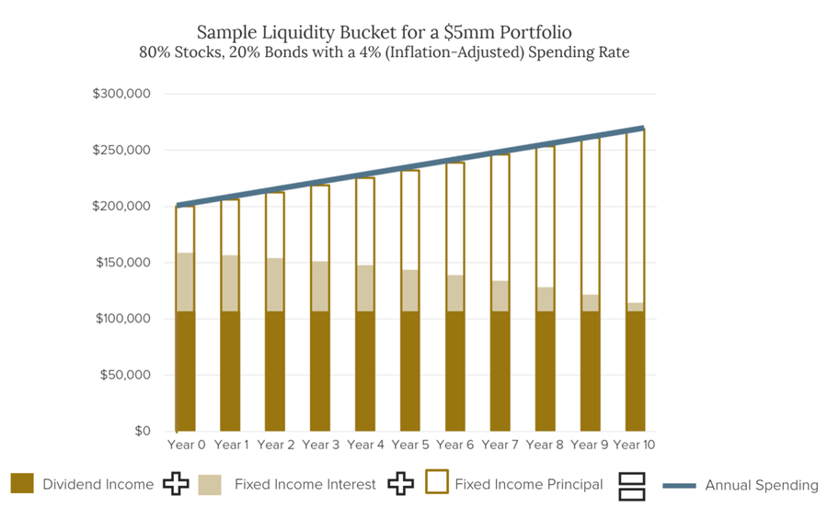
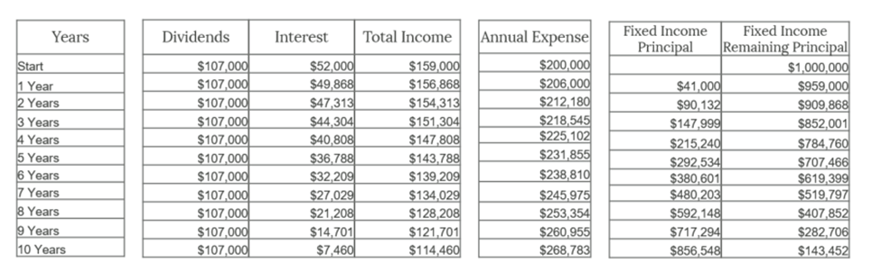
This is a $5 million portfolio with an 80/20 allocation, or $4 million invested in dividend-paying stocks (Crawford’s Dividend Growth strategy) and $1 million invested in high-quality bonds (Crawford’s Intermediate Core Bond strategy). This investor is taking $200,000 (4%) from the $5 million portfolio every year, and this initial amount has been adjusted for inflation each year (3%). Note how the dividend income from the equity portion of the portfolio and interest from the fixed income portion of the portfolio support spending needs. However, there is a spending shortfall, which is made up by liquidating the fixed income principal. One can see how the dividend income remains consistent because the equity principal is not being drawn down during the period. In reality, this is a conservative example, because the equity portion of the portfolio would likely experience growth of income, a benefit of investing in high-quality businesses, which is not accounted for in the display above. Differently, the interest from fixed income securities decreases because that portion of the portfolio is being drawn down as securities are liquidated.
The primary reason that the liquidity bucket approach works so well is the fact that all of the securities owned produce income. By investing in both income-producing bonds and stocks that produce a consistent stream of rising dividends, the time period that a client can live off of the combination of portfolio income and bond principal without having to sell stocks is drastically extended. With an approach of this nature, bonds can truly serve the purpose of preservation of capital and liquidity. As the yield or income generated by the equity portion of the portfolio increases, the size of the liquidity bucket required decreases, allowing a higher equity allocation over time. This example above uses Crawford’s flagship equity strategy, Dividend Growth, which is not even the firm’s highest-yielding equity strategy. A yield of roughly 2.7% is assumed for Crawford’s Dividend Growth strategy, while Crawford’s Dividend Yield strategy produces a yield of roughly 4.6%.
Our investment approach seeks to lend itself to consistent, predictable, and rising portfolio yield because we invest in what we believe are high-quality companies with the propensity to consistently increase their dividends. One of the benefits of owning a portfolio that produces a higher level of dividend income is that it allows an investor to maintain a smaller allocation to bonds while still having significant safety, as measured by the length of time of covered spending needs.
The ability of the equity portion of the portfolio to generate substantial income preserves the value of a liquidity bucket. If a portfolio can earn 4% in income, the liquidity bucket is not needed in a market decline. Because Crawford’s equity strategies generate a significant portion of total return from dividends, the need for the portfolio to experience price appreciation is dramatically lessened because the majority of a client’s spending needs are met through the dividend income provided by the portfolio.
What this means is that a client’s “liquidity bucket” wouldn’t be drawn down by 4% per year during a market decline, but rather a much smaller figure (0.5% to 2.0%) because the portfolio continues to generate its income throughout the downturn. This gives our clients much more confidence in their propensity to increase the equity allocation of their portfolio, which is a favorable outcome because stocks are the higher-returning asset class over time. This allows for greater compounding of principal and ultimately, higher portfolio values over time. Crawford’s approach to equity investing lends itself exceptionally well to utilizing a liquidity bucket, and we intend to continue using this approach for our clients.
In most environments, this portfolio would need to utilize a total return approach to generate the required distributions because the stock and bond markets will not offer enough in yield alone to meet the spending threshold. By total return approach, we mean the client will need to take distributions through both dividends/interest received and price appreciation from the stocks in the portfolio. In years where the stock market produces a positive return (which happens over 70% of the time), the 4% distribution threshold should be fairly easily attained because stock gains can simply be trimmed to make up the difference in income not earned by the portfolio. However, in market downturns and recessions, it is not so simple. This is when the value of a liquidity bucket is realized.
Footnote & Disclosure:
Past performance is not indicative of future results. The actual returns experienced by individual clients will differ due to many factors, including individual investments and fees, individual client restrictions, and the timing of investments and cash flows. Not every account will have these exact characteristics and there is no guarantee that another portfolio would have better or equal performance than the representative portfolio presented here. The strategies discussed may not be suitable for all investors. Investors must make their own decisions based on their specific investment objectives and financial circumstances.
Crawford Investment Counsel Inc. (“Crawford”) is an investment adviser registered with the U.S. Securities and Exchange Commission. Registration does not imply a certain level of skill or training. More information about Crawford, including our investment strategies, fees, and objectives can be found in our ADV Part 2 and/or Form CRS, which is available upon request.
This information is for illustrative purposes only. The opinions expressed are those of Crawford. The opinions referenced are as of the date of the commentary and are subject to change, without notice, due to changes in the market or economic conditions and may not necessarily come to pass. Crawford reserves the right to modify its current investment strategies and techniques based on changing market dynamics or client needs. CRA-2404-38

Diversification Not Over-Diversification
When looking at an investor’s retirement through a multi-decade lens, having a lower cost, tax-efficient, income-producing implementation focused on the most efficient asset classes allows for maximum effectiveness.

T-CRUTs After the SECURE Act
T-CRUTs can be a useful strategy that blend tax efficiency, income, control, and philanthropic intent.

The Dividend Effect
The Dividend Effect insulates investors from much of the volatility typically associated with investing.