
The 60/40 portfolio has long been the traditional framework for a balanced investment allocation, or at least a very popular starting point. It is believed by many that the combination of 60% stocks and 40% bonds will give investors exposure to the growth potential of stocks and the stability of bonds, which tend to be less volatile. Over the last couple of decades, many advisors have taken this allocation and modified it to include additional asset classes. These adjustments can include:
• Niche investment styles within a broader asset class like emerging market stocks or junk debt in bonds,
• Other asset categories altogether such as commodities and real estate, or
• Other security types such as private equity and debt, hedge funds, structured notes, options, etc.
The academic argument is that extra diversification will tilt the risk/return tradeoff in the investor’s favor. What is often overlooked is the “risk” part of the trade-off. These additional investments typically come along with additional risks in some form of increased volatility, illiquidity, lack of transparency, high expenses, less regulation, greater complexity (less understanding by the investor), limited accessibility, lower long-term returns, and tax complications, to name a few. Alternative investments often check several of these risk boxes.
When looking at the above list of risks more closely, a number of them are quite easy to compare and contrast relative to how portfolios are implemented at Crawford. For example, our use of individual stocks and bonds offers investors complete transparency, daily liquidity, a single layer of fees, customization, and income generation. But what about performance-related risks? These can be much more difficult to compare and contrast. Investment styles can differ widely within investment disciplines or asset classes. The appropriate allocation to a diversifying satellite strategy can be extremely difficult to quantify, and the timing of when to move in or out of that position always spurs a heated debate. That being said, for the sake of this exercise, let’s look at the historical returns and risk of a number of diversifying asset classes relative to U.S. stocks and a passive 60/40 portfolio over multiple periods of time and see what we can learn.
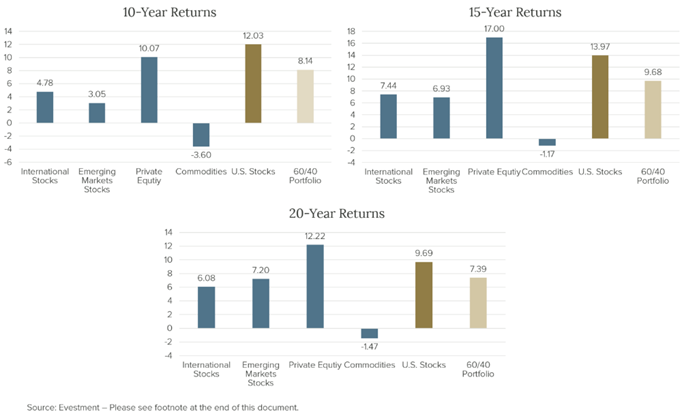
As you can see from the display above, many of these categories barely keep up with U.S. stock returns over time and eventually become a drag on returns the longer they are held in the portfolio. They are clearly best to be traded and held for shorter periods of time. Other categories do provide excess return over time, however, they take on significant additional volatility and have other drawbacks in providing that benefit. Let’s now look at the same asset categories and focus on risk using standard deviation, a measure of volatility.
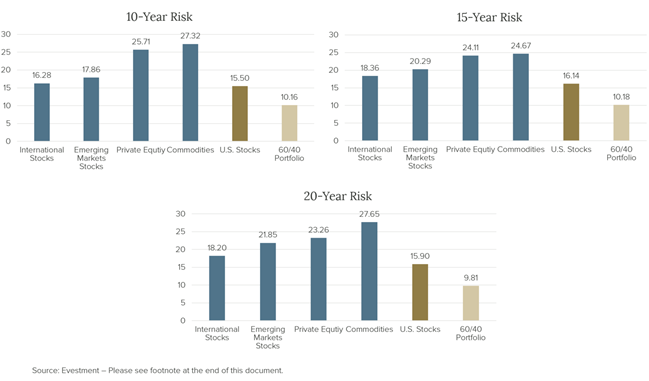
When taking the above data under consideration, it should be fairly obvious that the diversifying benefits of these more esoteric and higher-risk asset classes often do not offer benefits for investors when they are needed the most. What’s more, the display below demonstrates the average quarterly drawdown of these asset categories over the past 20 years. We believe drawdowns of this magnitude are an unacceptable outcome and can lead to a variety of negative ultimate investment outcomes.
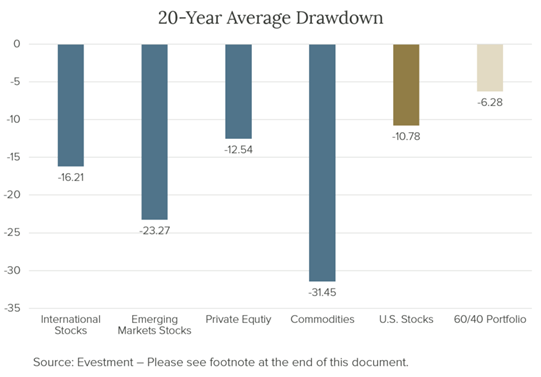
Clearly, U.S. stocks have been an attractive place to invest over the past few decades. The benefits of adding bonds in a 60/40 portfolio allocation also become clear when risk is taken into consideration. At Crawford, we go beyond the generic 60/40 portfolio and actively focus on high-conviction, high-quality U.S. securities, holding the belief that the most efficient asset classes in balancing risk and return are dividend paying stocks and high-quality bonds. These two asset classes typically offer the best diversification meaning they remain uncorrelated during times of market stress and participate in market advances over time. We appreciate the way they work together, particularly when there is a high-quality bias. A quality-oriented approach enables investors to allocate more to the higher-returning asset class (equity) while mitigating risk to a greater extent than is possible with a traditional allocation. Our approach also has the added benefit of current income generation. At the end of the day, we do not believe highly diverse or complex investment allocations are worth the tradeoff for our clients, and we believe our investors’ returns will compound at a more attractive rate because of our quality-oriented, active management process.
When looking at an investor’s retirement through a multi-decade lens, having a lower cost, tax-efficient, income-producing implementation focused on the most efficient asset classes allows for maximum effectiveness in compounding returns and accumulating perpetual wealth over a multi-decade framework.
Footnote & Disclosure:
Annualized data is calculated through 12/31/2023. Indexes used to represent various categories: International Stocks – MSCI EAFE Index, Emerging Market Stocks – MSCI Emerging Markets Index, Private Equity – Refinitiv Private Equity Index, U.S. Stocks – S&P 500 Index, 60/40 Portfolio – 60% S&P 500 Index, 40% Bloomberg US Aggregate Index rebalanced quarterly. The MSCI EAFE Index (Europe, Australasia, Far East) is a free float-adjusted market capitalization-weighted index that is designed to measure the equity market performance of developed markets, excluding the United States and Canada. The MSCI EAFE Index consists of the following 21 developed market countries: Australia, Austria, Belgium, Denmark, Finland, France, Germany, Hong Kong, Ireland, Israel, Italy, Japan, the Netherlands, New Zealand, Norway, Portugal, Singapore, Spain, Sweden, Switzerland and the United Kingdom. The MSCI Emerging Markets Index is a free float-adjusted market capitalization-weighted index that is designed to measure equity market performance of emerging markets. The MSCI Emerging Markets Index consists of the following 24 emerging market country indices: Brazil, Chile, China, Colombia, Czech Republic, Egypt, Greece, Hungary, India, Indonesia, Korea, Kuwait Malaysia, Mexico, Peru, Philippines, Poland, Qatar, Saudi Arabia, South Africa, Taiwan, Thailand, Turkey and United Arab Emirates. The S&P 500 Index is the Standard & Poor's Composite Index and is a widely recognized, unmanaged index of common stock prices. It is market cap weighted and includes 500 leading companies, capturing approximately 80% coverage of available market capitalization. The Bloomberg U.S. Aggregate Bond Index is an unmanaged index of domestic investment grade bonds, including corporate, government and mortgage-backed securities. The Refinitiv Private Equity Buyout Index is an index made up of independent portfolios intended to track the return of the private equity universe by replicating movements in the Refinitiv Private Equity Buyout Research Index. The RF PE Buyout Index seeks to replicate the return profile of the private equity buyout asset class by constructing a combination of sector portfolio returns. These sector portfolios are designed to track the performance of private equity sector investments by holding liquid exchange trade instruments rather than investing directly in private equity firms.
Crawford Investment Counsel Inc. (“Crawford”) is an investment adviser registered with the U.S. Securities and Exchange Commission. Registration does not imply a certain level of skill or training. More information about Crawford, including our investment strategies, fees, and objectives can be found in our ADV Part 2 and/or Form CRS, which is available upon request.
This information is for illustrative purposes only. The opinions expressed are those of Crawford. The opinions referenced are as of the date of the commentary and are subject to change, without notice, due to changes in the market or economic conditions and may not necessarily come to pass. Crawford reserves the right to modify its current investment strategies and techniques based on changing market dynamics or client needs. CRA-2404-37

Not Diversification, Dividendification!
We seek diversification by investing across various areas and sectors of the market, and we insist on dividendification in the name of achieving successful outcomes for our clients.

Common Sense Income Planning in Retirement
When looking at an investor’s retirement through a multi-decade lens, having a lower cost, tax-efficient, income-producing implementation focused on the most efficient asset classes allows for maximum effectiveness.

T-CRUTs After the SECURE Act
T-CRUTs can be a useful strategy that blend tax efficiency, income, control, and philanthropic intent.