
In our previous Compound Interest series posts, we have discussed the concept of a Liquidity Bucket. This practice allows investors to protect their portfolio's ability to consistently provide for spending needs and avoid liquidating stocks when they are temporally down in value. As explained in our previous piece, owning investment solutions that provide a stable and growing stream of income is one of the most powerful components in a successful long-term investment program.
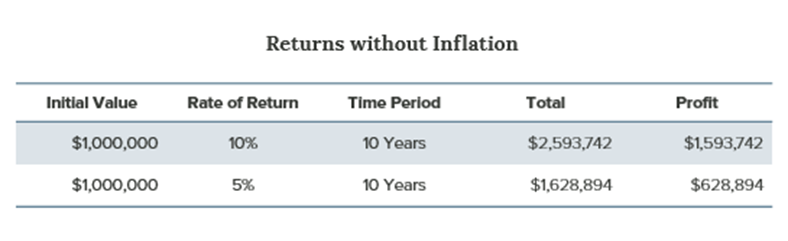
It is common knowledge that $1 million invested over a ten-year period can enjoy the benefits of compounding. And of course, how the $1 million is invested will have a disproportionate impact on the terminal value. While it makes sense that a higher-returning investment would generate higher profits, what many do not understand is the extent to which compounding magnifies profits at higher rates of return. For example, 10% is only 2 times 5%, but a 10% annualized return will generate over 2.5 times the profit of a 5% annualized return.
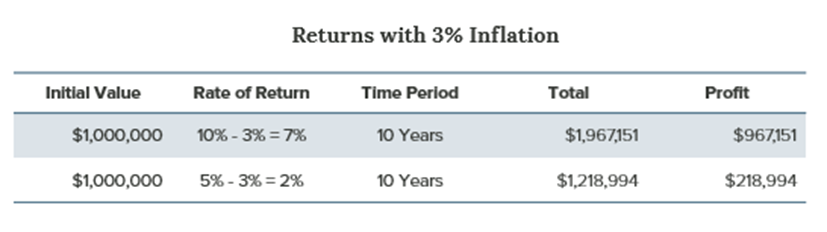
As we have been reminded in recent years, inflation is a variable that investors are unable to control. Its impact on future purchasing power will have a meaningful impact on the ultimate success of any investment program. However, the lower the return, the more disproportionate and magnified the effect of inflation becomes. Using the example above, if inflation is 3% over the 10-year period, the real profit generated from $1 million invested with a 10% return is actually 4.4 times greater than the real profit earned at 5%.
As a fiduciary, we must not lose sight of this concept when constructing portfolios. Clients who are attracted to our investment approach typically have two primary objectives. First, to utilize their portfolio to provide for their current and/or future spending needs. And second, to grow the real value of the portfolio as it relates to legacy planning. Because our equity strategies seek to obtain a rising stream of income, our approach is well suited to helping investors achieve these objectives.
To place actual figures around the concepts, it is helpful to gain some historical perspective. At Crawford, we have been managing our Dividend Growth strategy for 43 years. All stocks held in the portfolio pay a dividend, and we have a strong preference for stocks that demonstrate a long history of growing their dividends. Based on historical performance, a $1 million investment in the Dividend Growth strategy 10 years ago would be worth $2.4 million today, earning an annualized return of 8.92% (net of fees). More importantly, in the first year of holding that investment, the strategy generated $29,100 in dividend income. Today, that investment is expected to generate annual dividends of over $57,000. This reflects a 6.98% annualized growth rate in the income and a 5.71% yield on cost. This example assumes dividends were reinvested back into the portfolio.
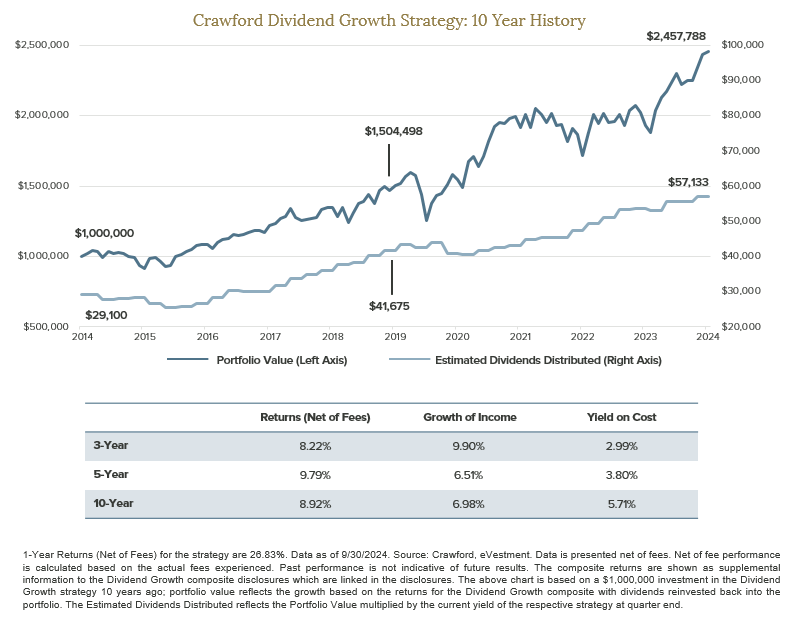
Owning a portfolio of companies that regularly increase their earnings and dividends is a powerful force. In the period evaluated, investors endured higher-than-normal inflation. Inflation, measured by CPI, was roughly 2% when the investment was initiated. However, in the aftermath of Covid, inflation moved to levels not seen in the last 35 years. Only until recently has inflation come back down to the 2.5% range. On a cumulative basis, prices are up 27.4% (3% annualized). Fortunately, the Dividend Growth strategy has seen both the value of the investments and dividends appreciate at a rate well above inflation. In real dollars, the investor has far more assets and income today than when they initiated the investment.
However, not all investors can own a portfolio of 100% stocks. This is why we utilize a Liquidity Bucket with some investors to help ensure their needs are met. Bond investors need to factor in the impact of inflation, as the future value of any investment will decline in current dollars by whatever the inflation rate is over the holding period. Typically, a bond investor receives what they paid for the bond when it matures, along with a constant stream of interest income. The greater certainty of cashflows has allowed bonds to be one of the most effective ways to diversify the risk of owning stocks. Their ability to preserve capital in poor economic/market conditions makes them an excellent source of liquidity when stocks are down in value. At the same time, we caution long-term investors to be careful when establishing asset allocation parameters to make sure the portfolio has the ability to both generate a reasonable level of income and, more importantly, to grow its income and principal value at a rate in excess of inflation.
We find many investors tend to be overly conservative and fail to play the long game. Exploiting a higher rate of return has a disproportionately positive benefit to a portfolio’s value as the time horizon expands. At Crawford, for over 40 years, our investment approach has allowed investors to allocate more to the higher-returning asset class as our equity strategies attempt to hold a lower level of overall risk. The ability to grow the long-term value of the portfolio while also growing the income is a powerful force helping clients to achieve successful outcomes.
Footnote & Disclosure:
To view a copy of the Dividend Growth composite disclosure, visit the following link: https://info.crawfordinvestment.com/hubfs/Dividend%20Growth%20Composite%20Report%20-%202024%2009%2030.pdf
Crawford Investment Counsel (“Crawford”) is an independent investment adviser registered under the Investment Advisers Act of 1940, as amended. Registration does not imply a certain level of skill or training. More information about Crawford, including our investment strategies, fees, and objectives, can be found in our Form ADV Part 2 and/or Form CRS, which is available upon request.
The opinions expressed are those of Crawford. The opinions referenced are as of the date of the commentary and are subject to change, without notice, due to changes in the market or economic conditions and may not necessarily come to pass. There is no guarantee of the future performance of any Crawford portfolio. Crawford reserves the right to modify its current investment strategies and techniques based on changing market dynamics or client needs.
Material presented has been derived from sources considered to be reliable, but the accuracy and completeness cannot be guaranteed.
CRA-2411-3

New Year's Resolutions for Your Portfolio
The good news about these resolutions? We are certain we will keep them. We have a time-tested philosophy and a 40+ year history of sticking to it.

Adding Alpha
Our Dividend Growth strategy has a 40-year track record of success and positive alpha generation.

The Dividend Effect
The Dividend Effect insulates investors from much of the volatility typically associated with investing.