

The best performing stocks today are those that are expected to continue rapidly expanding operating profits. Operating profit designates the money made by a company after it pays for all of its direct expenses. Operating profit can also be thought of as a company’s profit before paying interest, taxes, and third party expenses. It is a useful metric for tracking the earnings from a company’s core business in a given period. Often, operating profits are expressed as a percentage of sales, or operating margins.
Currently, market participants are focused on innovation, such as Artificial Intelligence (AI), which allows the largest companies to earn greater operating profits. This can be readily seen in the chart below, outlining the margin expansion in the Tech sector versus the rest of the stock market over the prior decade.
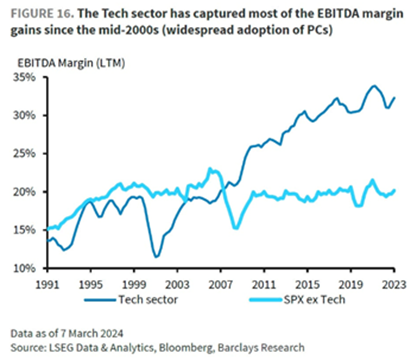
Currently, it is clear the Information Technology sector (INFT) is much more profitable than the overall market as represented by the S&P 500 Index (SPX). The second most profitable sector is Communications Services (COMM), which includes such companies as Meta Platforms and Alphabet, considered by many as technology companies. More traditional sectors of the economy, such as Consumer Staples, Health Care, and Industrials are at the lower end of operating profitability, currently.

When we see data such as this, we utilize common sense to perform sanity checks. What is a sanity check? It is using an alternative primary data source to test the hypothesis. If the trend holds up on two disparate sets, it is much more likely a sustainable business and investing trend. One good data alternative is FRED, a large public database provided by the Federal Reserve Bank of St. Louis.
In aggregate, FRED’s data shows two long-standing streams of corporate profits, below. The lighter blue line is closest to operating profit, while the darker blue line represents a metric closer to net profits. Net profit is the amount of cash left for shareholders after all expenses have been paid, which in this case is labeled as normalized aggregate profits after taxes and interest.
For operating profit, the sanity check works. The upward trend in normalized earnings before interest and taxes is what we would expect when one of the largest sectors in the economy is seeing operating margin expansion. However, the sharp spike in net profit (after tax and interest profit) was surprising. The increase in net profit could potentially present a bigger challenge for investors.
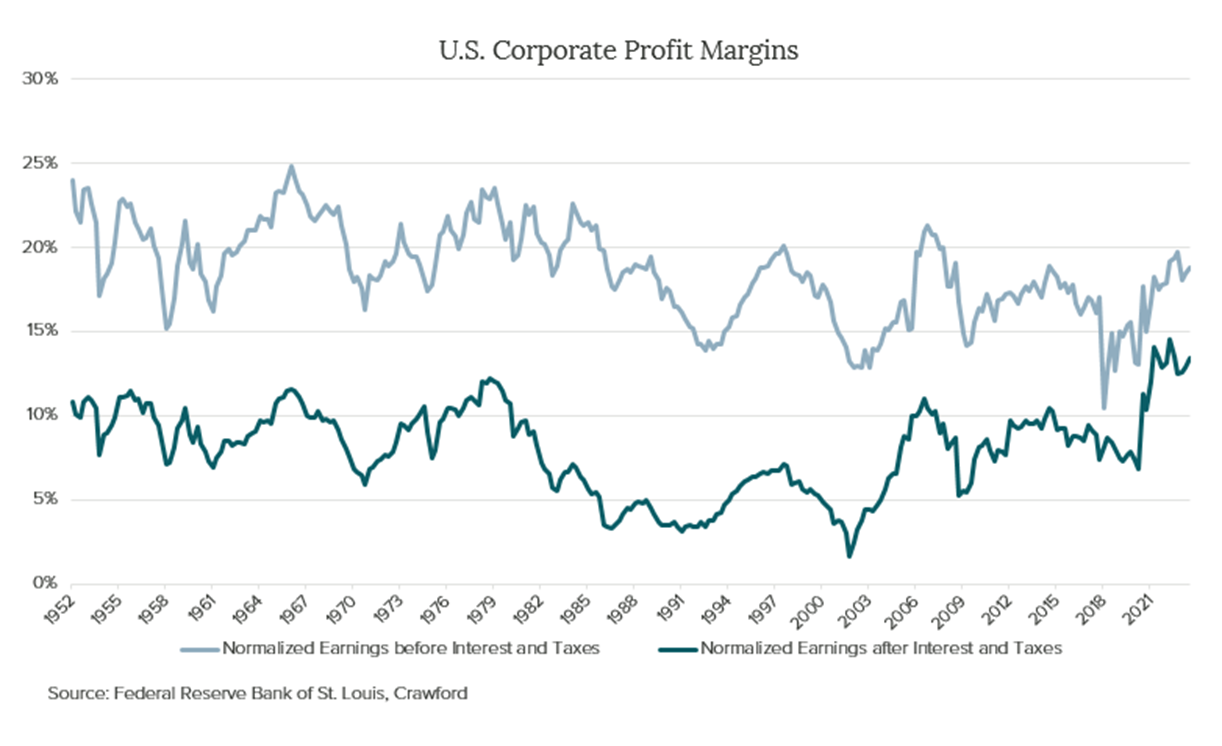
What has caused net profit margins for U.S. companies to almost double in the last five years? The easiest answer is very cheap debt and lower taxes. Corporations have taken on an increasing amount of debt as interest rates have declined. Debt, as measured as a percentage of revenue, has increased over 30% in the last decade, while interest expense on that debt has declined by about a third. With extremely loose monetary policy and ultra-low interest rates following the Covid pandemic, corporations levered up at a significantly lower cost. A secondary driver is accommodative government policies, including a change in the tax code and increased subsidies to invest in American plants and equipment instead of overseas.
At this point, we question the sustainability of both trends, not only Information Technology operating margins but also higher net margins from corporate America. The larger macro data set for operating profits shows cycles with the trend near a 20-year high and tax rates remaining relatively low. As profit margins regress toward the mean, we believe investors should be focused on companies with strong balance sheets and excess free cash flow, characteristics of quality companies that can weather refinancing at potentially higher interest rates. Additionally, investors should seek companies with sustainable business models, especially those with durable growth, pricing power, and some type of competitive advantage. At Crawford, we focus on building portfolios for our clients that include such high-quality, dividend paying stocks.
Disclosures:
Crawford Investment Counsel (“Crawford”) is an independent investment adviser registered under the Investment Advisers Act of 1940, as amended. Registration does not imply a certain level of skill or training. More information about Crawford, including our investment strategies, fees, and objectives, can be found in our Form ADV Part 2 and/or Form CRS, which is available upon request.
The opinions expressed are those of Crawford. The opinions referenced are as of the date of the commentary and are subject to change, without notice, due to changes in the market or economic conditions and may not necessarily come to pass. There is no guarantee of the future performance of any Crawford portfolio. Crawford reserves the right to modify its current investment strategies and techniques based on changing market dynamics or client needs.
Material presented has been derived from sources considered to be reliable, but the accuracy and completeness cannot be guaranteed.
CRA-2404-36

Always Higher, Never Lower
The projected deadline for a government shutdown is June 1, as tax receipts collected through April 15, 2023 were slightly lower than originally forecasted. Why should this be watched more closely than usual?

Can Your Portfolio Withstand Divided Government?
In a period where fiscal policy and monetary policy seem to be at odds, we believe investors should participate in the market via high-quality companies.

Why Are So Many Gamblers Looking to Be Zeroed Out?
Our process and these companies weren’t built in a day, and serious investors should remember that wealth rarely comes from short-sighted endeavors.