
Active investment managers seek alpha, which is the component of the Capital Asset Pricing Model (CAPM) that indicates outperformance relative to an index. The CAPM equation rests on the idea that higher risk, or more volatile (measured through beta) investments, should provide higher returns over time. While this is not necessarily the case, it is the basis on which many investors value stocks and attempt to explain the relationship between risk and return. Alpha has become shorthand for “beating the market,” and the difficulty of achieving this has led many to pursue a passive investment approach. We will spare you the specifics of the CAPM equation, but suffice it to say that it can be utilized to help evaluate an investment strategy’s risk-adjusted relative performance. The two primary components of the CAPM equation are alpha or “value-added” and beta or “volatility.” The formula enables a comparison of results on a risk-equivalent basis.
At Crawford, through investing in high-quality companies at attractive valuations, we narrow the range of investment outcomes, improve the chance of success, mitigate the likelihood of adverse returns, and enhance the return pattern. The result is that our strategies have far lower risk than the major market indices as measured by beta. And not only do our strategies have far lower risk, but they also produce positive alpha.
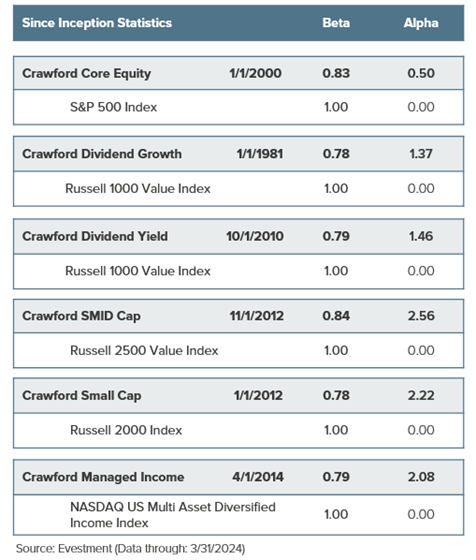
To be more specific, beta is the level of volatility, or risk, of any given investment relative to a benchmark. Beta for the selected benchmark is indexed to 1.00, and a lower beta indicates lower risk, while a higher beta indicates more risk. Alpha, on the other hand, represents the excess return earned per unit of risk taken. Alpha for the selected benchmark is always indexed at 0.00, and positive alpha indicates higher, risk-adjusted returns. Calculations for beta and alpha are always produced relative to a chosen benchmark. Academic research suggests that the presence of positive alpha is not sustainable, yet the positive alpha generation of Crawford’s strategies is persistent and meaningful when looked at in relation to the strategies’ primary benchmarks since each strategy’s respective inception.
In other words, Crawford’s strategies have provided superior results to what one would expect, given the risk assumed and overall market returns. Or, Crawford’s positive alpha indicates that our returns are stronger than the benchmark when the degree of risk taken is considered. Suffice it to say, the high positive alpha of our strategies is a result of both our industry-leading risk management and the edge we are able to gain through our in-house research and stock selection process. An intended result of our consistently applied process is the delivery of both low volatility and protection on the downside. Through narrowing the range of outcomes, we improve the chances for success, tend to mitigate the likelihood of adverse returns, and enhance the return pattern. Over time, these factors work together to produce alpha. It cannot be emphasized enough that dividend-paying companies provide lower risk, and when carefully selected utilizing a rigorous investment process, they can produce alpha.
Investing in quality mitigates risk in the event of a downturn, but it also empowers upside participation to enable long-term outperformance. Everybody knows the market goes up more than it goes down, but our strategy’s long-term outperformance is most frequently realized in periods of market stress. Hence our conviction that we provide “alpha when you need it most.” We go forward with great confidence in the belief that our focus on high-quality companies insulates our investors from much of the volatility typically associated with investing, empowering outperformance in periods of market stress. We continue to believe the merits of our low-volatility investment approach will be realized through long-term, positive alpha generation.
Disclosure:
Crawford Investment Counsel (“Crawford”) is an independent investment adviser registered under the Investment Advisers Act of 1940, as amended. Registration does not imply a certain level of skill or training. More information about Crawford, including our investment strategies, fees, and objectives, can be found in our Form ADV Part 2 and/or Form CRS, which is available upon request.
The opinions expressed are those of Crawford. The opinions referenced are as of the date of the commentary and are subject to change, without notice, due to changes in the market or economic conditions and may not necessarily come to pass. There is no guarantee of the future performance of any Crawford portfolio. Crawford reserves the right to modify its current investment strategies and techniques based on changing market dynamics or client needs. Material presented has been derived from sources considered to be reliable, but accuracy and completeness cannot be guaranteed. CRA-2405-2

Generating Income and Exploiting Inefficiencies
Our Managed Income Strategy generates attractive, income-oriented returns with lower risk by exploiting these opportunities in higher-yielding securities.

Investing Successfully in a World of Uncertainty
Higher volatility, or more risky strategies, are theoretically supposed to provide higher returns.

Interview with the Core Equity Portfolio Manager
At Crawford, all of our strategies help investors achieve a specific set of goals and solve for certain needs. Clients are attracted to the Core Equity strategy because it has a higher focus on growth than other Crawford strategies.