

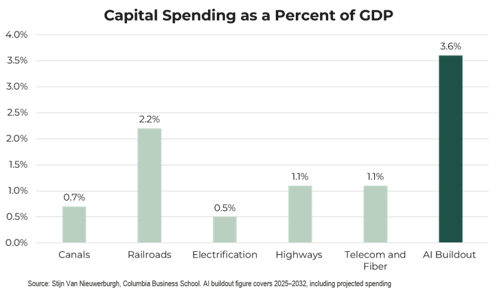
Artificial intelligence has quickly developed a language of its own. Terms such as large language models, agents, tokens, open-weight models, and compute now appear regularly in corporate earnings calls, capital spending plans, and discussions about the broader economic and investment outlook. Understanding these concepts helps explain the economics behind one of the largest investment cycles underway today. This includes how AI is developed, consumed, and monetized, what resources are required to support it, and where competitive advantages may ultimately reside. Those questions are becoming more important as spending expectations continue to rise. To provide some context, Amazon recently increased its expected 2026 capital spending by approximately 10% to $220 billion, Alibaba had already spent roughly half of a three-year, $56 billion AI and cloud infrastructure commitment by June 2026, and OpenAI’s reported compute spending expectations through 2030 increased from approximately $600 billion to $750 billion within months. The pace of these revisions reflects both strong demand and the difficulty of forecasting such a rapidly evolving industry, while reinforcing a familiar investment principle. AI may have introduced a new vocabulary, but evaluating the businesses participating in it still requires fundamental analysis of demand, pricing power, competitive advantages, margins, capital intensity, and return on invested capital.
Hyperscalers: A lot of today’s AI discussions begin with hyperscalers. Hyperscalers are large technology companies that operate extensive cloud-computing and data-center infrastructure capable of supporting enormous workloads. A relatively small group of companies, including Amazon, Microsoft, Google, and Meta, account for a large share of global cloud and AI infrastructure spending. As a result, their capital allocation decisions can meaningfully influence demand across semiconductors, networking equipment, data centers, power infrastructure, and other parts of the AI ecosystem.
Large Language Models: Large language models (LLMs) are AI systems trained on enormous amounts of information to identify patterns and relationships within language and other forms of data. Rather than retrieving a predetermined answer from a database, an LLM uses what it learned during training to predict and generate an appropriate response to a new prompt.
Companies such as OpenAI, Anthropic, Google, and Meta invest substantial amounts to develop LLMs which customers can often access through an Application Programming Interface (API). Semiconductor companies provide the processors needed to train and operate them. Cloud providers supply computing capacity. Software companies incorporate the models into products, while businesses across virtually every industry are beginning to apply them to internal processes and customer-facing applications. As this ecosystem develops, the investment question is increasingly where the economic value created by those capabilities will accrue. The following concepts help frame that question.
Agents: Most consumers were introduced to generative AI through chatbots. An AI agent goes further by using a model to pursue an objective, make intermediate decisions, and interact with other software or information sources to complete a larger task. Software that historically required a person to initiate each step can therefore execute a larger portion of a workflow.
Agents have the potential to increase demand substantially across model providers, cloud platforms and computing infrastructure. It also makes the economics more complicated. The value of an agent depends not only on what it can accomplish, but also on the amount of computing required to accomplish it and whether the economic benefit to the customer exceeds that cost.
Tokens: In LLMs, text is divided into smaller units known as tokens, which can represent words, portions of words, punctuation, and other pieces of information. Models process the tokens submitted by a user and generate additional tokens in response. Companies accessing a model through APIs, frequently pay based on the quantity of information processed and generated. A simple request may use relatively few tokens, while asking a model to analyze extensive documents, reason through multiple steps, or operate an agent over a prolonged period can require substantially more.
The rapid growth in AI usage should not be viewed as synonymous with profitability. As models, chips, and software become more efficient, the cost of generating AI output continues to decline, broadening the addressable market and encouraging greater usage. While this can drive significant growth in token volumes, lower prices may also reduce the revenue earned per unit of consumption. The ultimate economics therefore depend not only on volume growth, but also on pricing, computing costs, and efficiency gains. A company can process substantially more tokens and create meaningful value for customers without necessarily generating a commensurate increase in revenue or margins.
This distinction is increasingly relevant as the industry scales. The 2026 Stanford AI Index estimated that the annualized revenues of leading AI companies had risen from approximately $2 billion in 2023 to more than $70 billion by early 2026. Over roughly the same period, annualized capital expenditures by major hyperscalers increased from approximately $150 billion to a projected $770 billion. Both sides of the equation are growing extremely rapidly, making the relationship between revenue growth and the capital required to produce it increasingly important.
Open-Weight Models: The weights of an AI model are the numerical parameters developed during training that help determine how it interprets information and generates responses. With a proprietary or closed model, customers generally access those capabilities through an API controlled by the model developer. With an open-weight model, the model weights are made available so that outside organizations can download the model, operate it on their own infrastructure and, depending on its license, customize it for their needs.
Open-weight is not necessarily synonymous with open source, and different models carry different licensing and usage restrictions. From an investment standpoint, however, the larger issue is competition. Customers may not need to rely exclusively on one leading proprietary model if sufficiently capable alternatives can be deployed more cheaply or adapted internally.
Current developments illustrate how quickly this competitive landscape can change. Chinese developers in particular have advanced increasingly capable open-weight models while operating with more limited access to leading-edge computing hardware. Z.AI, for example, has emerged as a significant competitor with open-weight models despite spending considerably less than the largest U.S. AI developers.
Compute: Although AI is generally discussed as software, its operation depends on a substantial physical infrastructure. Compute refers broadly to the processing resources required to develop and operate AI systems. Delivering it requires advanced semiconductors, servers, high-speed networking equipment, data centers, cooling systems, and increasingly significant amounts of electricity.
Value could accrue to model developers, but it may also accrue to semiconductor manufacturers, cloud providers, software platforms, data-center operators, or existing businesses that use AI to improve productivity, deepen customer relationships, or reduce costs. Simply identifying companies with AI exposure provides relatively little insight into which of those businesses will ultimately retain the economics created by the technology.
The magnitude and acceleration of these spending plans make return on capital increasingly important to the AI investment thesis. Capital expenditures create infrastructure that companies expect to produce future revenue, cost savings or other economic benefits. For those investments to create shareholder value over time, the cash flows generated by the assets ultimately need to justify both their upfront cost and the ongoing expense required to operate them.
It is important to note that the accounting effects arrive over time. Cash is committed as facilities and equipment are built. Once assets enter service, depreciation expense increases, while data-center operations require electricity, cooling, maintenance, and other costs. Advanced processors may also have relatively short economic lives because subsequent generations can deliver considerably greater computing performance. These costs can affect reported margins and free cash flow even while AI-related revenue is expanding rapidly, and this is already visible in company results.
An expanding market does not necessarily confer the same economics on every participant, and the companies investing the greatest amounts of capital will ultimately need to demonstrate that those investments can produce attractive incremental returns. In other words, AI has changed the vocabulary surrounding technology investing, but it has not changed the questions that determine long-term investment outcomes. As spending projections continue to expand, we believe those questions become more relevant. At Crawford, we continue to adhere to our fundamental, bottom-up research process, focused on identifying high-quality companies at what we believe are attractive valuations.
Disclosures:
Crawford Investment Counsel Inc. (“Crawford”) is an investment adviser registered with the U.S. Securities and Exchange Commission. Registration does not imply a certain level of skill or training. More information about Crawford’s investment advisory services can be found in our ADV Part 2 and/or Form CRS, which is available upon request. The opinions expressed are those of Crawford Investment Counsel as of the date of publication and are subject to change due to changes in the market or economic conditions and may not necessarily come to pass. Forward-looking statements cannot be guaranteed. Past performance is not indicative of future results. There is no guarantee of the future performance of any Crawford portfolio. All investments involve risk, including loss of principal, and there is no guarantee that investment objectives will be met. CRA-2609-2

Innovation & Transformation: Investing in AI
Given the pace of innovation and the rapid adoption of generative AI technologies, now is an exciting time to be an investor in companies with AI exposure. At Crawford, we can take advantage of these opportunities by identifying individual companies that both meet our quality requirements AND participate in these secular growth markets.

Generative AI: Generating Investment Opportunity
In November, the release of OpenAI’s ChatGPT marked the beginning of the commercial phase of the global race in artificial intelligence.

AI Competition and the Software Investment Narrative
AI has introduced uncertainty into enterprise software by inserting a powerful new layer between users and traditional applications.