
After five straight months of positive returns for stocks and bonds, both asset classes took a breather in October. Modest declines occurred in stocks. Bonds declined a bit more significantly as they reacted to some monthly inflation news that was less favorable than expected as well as shifting expectations over how aggressive the Federal Reserve (Fed) might be with their interest rate reductions. However, the pause in the stock market ended abruptly the day after the presidential election with share prices advancing sharply.
While it is difficult to know precisely what the short-term performance of stocks or bonds is reflecting, several inferences can be taken from the market’s initial response to Trump’s decisive victory. He ran strongly on tariffs, deregulation, and lower taxes. With a mandate and both houses of Congress behind him, extensions, if not further reductions, of his 2017 tax package seem likely. Combined with less regulation, the impetus is expected to be toward higher growth for the economy. Common stock investors are welcoming these factors. On the other hand, tariffs are assumed to be inflationary, especially in the context of higher economic growth. Inflation is the enemy of fixed income, thus the modestly negative initial reaction of bond investors to the policy implications of the Trump agenda.
We hasten to point out that the above comments are based on campaign promises, and time will tell how much of the proposed agenda is enacted. Right now it looks so clear, but, as we enter the new year uncertainties will likely increase. Furthermore, we are writing on just a week or two of market action, something that has the potential to change dramatically as things settle in and investors learn more. Of far more importance for investors will be the longer-term picture for the economy, what secular forces exert influence over it, and how this will be reflected in the action of stocks and bonds.
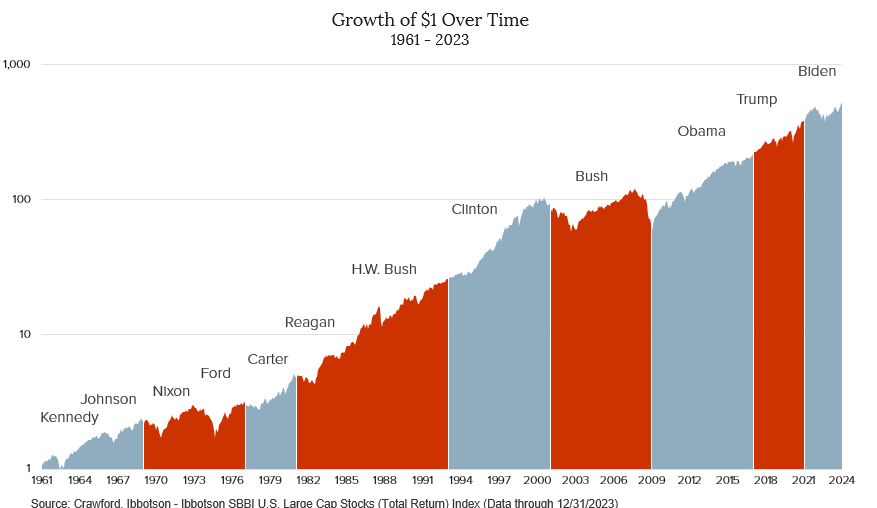
Perhaps a review of history might be helpful. The above chart demonstrates that with just about every president, the stock market has expanded. Currently, what we know for sure is that our economy is performing well. We can hope that whatever policy changes are implemented will lead us further in the direction of consistent economic growth that is achieved within the natural limits of its potential, with low and sustained inflation. Such a combination will inspire confidence among corporate citizens to make lasting and productive investments, leading to favorable outcomes for shareholders. Regardless of whether this most favorable scenario unfolds, we maintain faith that over the long run our economy will provide a setting in which companies can prosper, especially the high-quality ones that we prefer. There will always be challenges, and our goal is to identify those companies that are best equipped to successfully navigate the challenges through balance sheet strength, management, and profitability.
As we move forward, we will, of course, be monitoring political events as they unfold, but we will also be focusing on the things that we can control, namely, making sure the portfolios contain high-quality securities that we believe will be successful investments.
Disclosures:
The opinions expressed are those of Crawford Investment Team. The opinions referenced are as of the date of publication and are subject to change due to changes in the market or economic conditions and may not necessarily come to pass. Past performance does not guarantee future results. Forward looking statements cannot be guaranteed. Crawford is an investment adviser registered with the U.S. Securities and Exchange Commission. Registration does not imply a certain level of skill or training. More information about Crawford’s investment advisory services can be found in its Form ADV Part 2, which is available upon request. Material presented has been derived from sources considered to be reliable, but the accuracy and completeness cannot be guaranteed. Crawford reserves the right to modify its current investment strategies and techniques based on changing market dynamics or client needs.
CRA-2411-2

Mid-Quarter Update - November 2025
We continue to focus on high-quality companies with durable cash flows, conservative balance sheets, and the ability to compound value over time.

December 2024 | Quarterly Letter
We are not sure if we are in a new paradigm of growth for the economy, but for now things are moving in the right direction. This is good. However, we must deal with a stock market that is richly priced by historical standards and a bond market that is uncertain.

June 2020 | Quarterly Letter
The first half of 2020 will long be remembered as one of the more unusual and difficult periods in investment history.