


One of the most striking anomalies we have observed in our 45-year history of investing is that higher-quality small cap companies deliver higher long-term returns with lower volatility. This runs counter to the idea that higher risk leads to higher return over time, a particularly prevalent viewpoint among small cap investors. Yet the historical experience of dividend-paying small caps (as a proxy for quality) challenges that assumption. We believe this opportunity persists in large part because of a neglect effect. That is, these businesses (and their stocks) do not typically attract the attention that their fundamentals warrant. Our value-oriented approach seeks to capitalize on that disconnect by identifying both quality and growth potential that is not fully reflected in smaller company share prices (link to QARP piece in online version).
While dividends do not automatically equate to quality, they do provide a useful starting point for identifying it, particularly in smaller companies. Dividend payments can seem counterintuitive in small cap investing, where investors often expect companies to reinvest all available cash for growth. However, we have found that the most attractive small cap companies are those that generate enough cash to internally fund attractive growth opportunities while also actively and consistently returning capital to shareholders. We view the ability to do both as an indication of business quality, financial strength, and disciplined capital allocation.
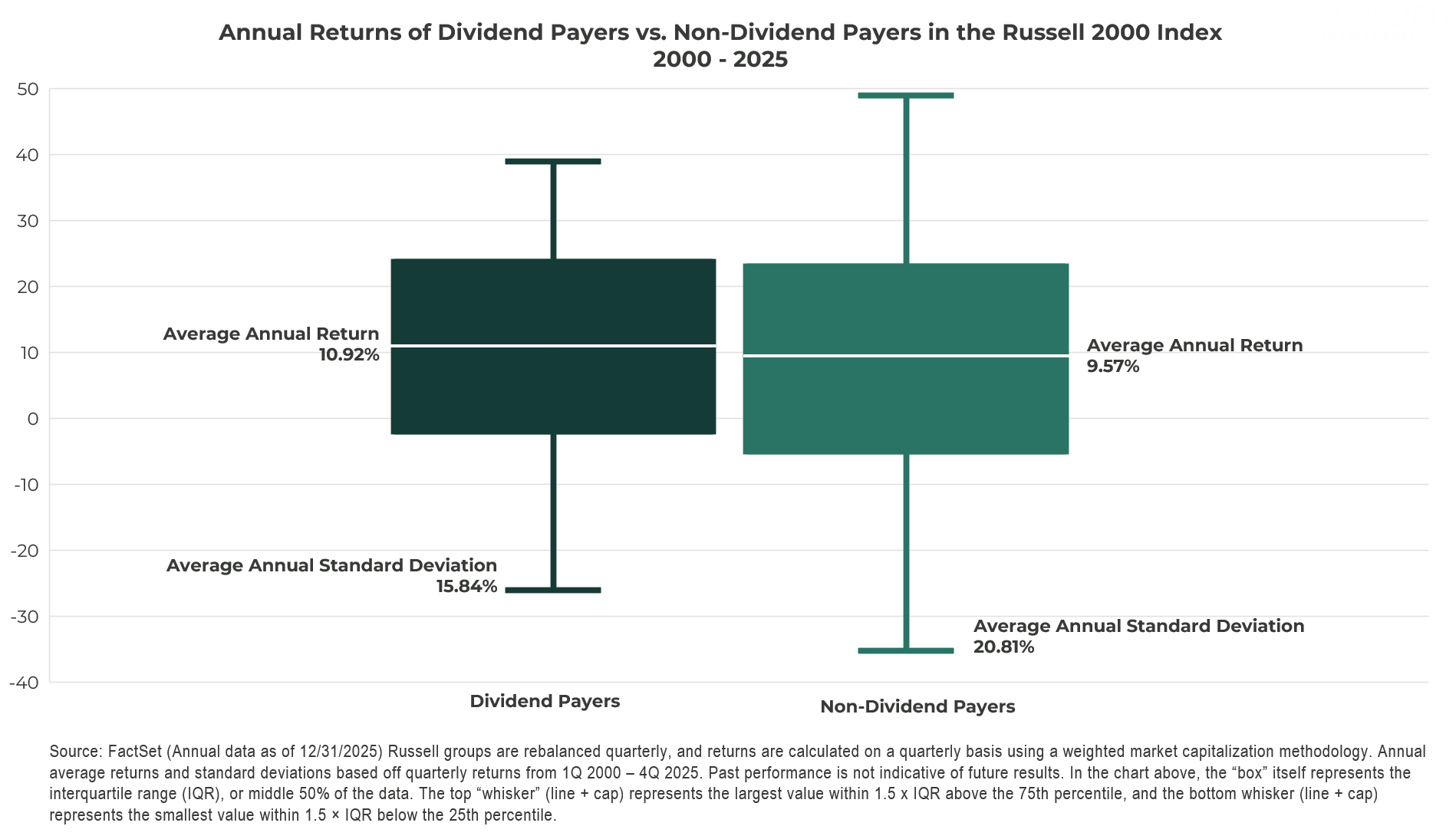
The display above indicates that from 2000 through 2025, dividend payers within the Russell 2000 Index produced an average annual return of 10.92%, compared with 9.57% for non-dividend payers. This return advantage was experienced with substantially lower volatility. We believe four factors help explain this low beta phenomenon:* the economics of research coverage, investor behavior, investment industry incentives, and the discipline imposed by returning capital to shareholders.
First, the economics of Wall Street investment research can contribute to limited coverage of higher-quality smaller companies. Businesses that generate sufficient cash to fund their operations and growth often have less need for external capital, reducing their demand for underwriting and other capital markets services from the same Wall Street firms that publish investment research. Combined with lower trading volumes, this can reduce the commercial incentive for brokerage firms to devote research resources to these companies. Smaller companies generally receive less coverage, particularly those that are higher quality. This creates an inefficiency in the marketplace in terms of delayed recognition of durable earnings, cash flow, and competitive advantages. This neglect consistently creates opportunities for investors to identify business quality before it is fully reflected in valuation.
Second, investor preferences and investment industry incentives can often favor speculative and aggressive investment opportunities over consistent business performance. As investors move down the market cap spectrum, both business and stock price volatility increases. This enhances the appeal of finding an exceptional winner. Young companies with large addressable markets or ambitious turnaround plans tend to capture more attention than established businesses delivering consistent and predictable earnings and dividend growth. This lottery ticket type appeal can lead investors to gain-seeking behavior known as Prospect Theory,** whereby they place too much weight on the possibility of an extraordinary outcome and too little on the likelihood of disappointment.
Third, professional incentives can often reinforce the tendencies listed above. Investment managers and especially shorter-term investors are typically evaluated and compensated against a benchmark over periods much shorter than a standard business cycle. A portfolio of steadier companies can lag during a speculative rally, creating pressure to participate, as strong near-term performance can attract client assets and increase fee revenue. Analyst incentives and traders are often geared toward the upside, leading to an agency problem where many active investment strategies carry a beta factor substantially higher than 1.0. This imbalance can be further exacerbated by hedge funds and long-short investors, all of which can encourage risk-taking and help explain why higher-quality dividend-paying companies can remain underappreciated.
Finally, returning capital to shareholders can reinforce business discipline and add to total shareholder returns (TSR). Retaining every dollar does not ensure that every dollar will be invested well. Companies with excess cash and those lacking capital allocation discipline can often pursue marginal projects, overpay for acquisitions, or expand without sufficient regard for returns. A recurring dividend, on the other hand, reduces the cash available for discretionary spending and forces management to prioritize only the highest return investments. For this reason, we view a sustainable dividend as both an indicator of underlying business quality and often a means toward both sustainable earnings growth and a higher return on invested capital (ROIC).***
That capital allocation discipline complements the underlying financial advantages of quality. A company with manageable debt, consistent cash flow, and a defensible competitive position has greater flexibility when conditions weaken. It may be able to continue investing while a financially stretched competitor must cut spending, forego opportunities, or raise expensive capital/issue shares at an unfavorable price. Over a full cycle, we believe avoiding financial impairment and sustaining productive investment is as important as achieving growth during favorable conditions. All of this helps with downside protection, an essential element in compounding wealth and avoiding permanent loss of capital.
We believe these inefficiencies create an opportunity for quality-oriented investors performing fundamental, bottom-up research and maintaining a longer time horizon. Our small cap screening process includes a three-year dividend history alongside earnings stability, profitability, free cash flow generation, and balance sheet strength. We then examine the business model, industry and competitive conditions, management and incentives, and overall consistency of the company to determine whether those qualities are likely to endure. We assess shareholder friendliness and whether a company can sustain its dividend, finance attractive growth opportunities, and allocate capital effectively through a range of conditions.
Valuation connects this work to the investment decision. A strong business can still be a poor investment if its price assumes too much future success. Our value-orientation further mitigates overall risk by identifying high-quality companies when short-term business concerns, limited attention, or shifting investor preferences create an attractive relationship between price and long-term prospects.
Higher-quality companies will not outperform in every environment, and patience is necessary when speculative stocks lead. This is the trade-off we are willing to make in the interest of earning above-average returns with below average risk. The small cap quality anomaly is alive and well, and we intend to continue to exploit this to the benefit of our investors.
Definitions:
*The low-beta phenomenon (also called the low-volatility anomaly) is the empirical observation that stocks with low systematic risk (low beta) have historically delivered higher risk-adjusted returns than stocks with high beta. This directly contradicts standard financial theory, such as the Capital Asset Pricing Model (CAPM), which assumes that investors must be compensated with higher expected returns for taking on higher market risk (higher beta).
**Prospect Theory describes where investors experience asymmetric perceptions of risk and reward, occasionally leading to a reckless disregard for the return of capital in pursuit of the return on capital.
***ROIC: In the paper, "Surprise! Higher Dividends = Higher Earnings Growth" by Robert D. Arnott and Clifford S. Asness (published in the Financial Analysts Journal, 2003), Arnott and Asness directly challenged a standard assumption in corporate finance: that retaining earnings to reinvest in the business naturally fuels faster future earnings growth. Instead, they discovered that future earnings growth is fastest when current payout ratios are high, and slowest when payout ratios are low. This outperformance is fundamentally tied to capital discipline and the mitigation of agency costs.
Disclosures:
Crawford Investment Counsel Inc. (“Crawford”) is an investment adviser registered with the U.S. Securities and Exchange Commission. Registration does not imply a certain level of skill or training. More information about Crawford’s investment advisory services can be found in our ADV Part 2 and/or Form CRS, which is available upon request. The opinions expressed are those of Crawford Investment Counsel as of the date of publication and are subject to change due to changes in the market or economic conditions and may not necessarily come to pass. Forward-looking statements cannot be guaranteed. Past performance is not indicative of future results. There is no guarantee of the future performance of any Crawford portfolio. All investments involve risk, including loss of principal, and there is no guarantee that investment objectives will be met. CRA-2611-2

