Smaller companies are often earlier in their lifecycle, operate in less mature markets, and have greater opportunities to expand their businesses than many of their larger counterparts. However, that potential comes with increased risks and a wider range of possible outcomes. Smaller companies frequently have narrower product lines, greater customer concentration, more limited access to capital, higher financial leverage, and greater sensitivity to changes in the economic environment. In a market segment known for both opportunity and uncertainty, we believe a disciplined focus on business quality and valuation provides a durable framework for identifying attractive long-term investments.
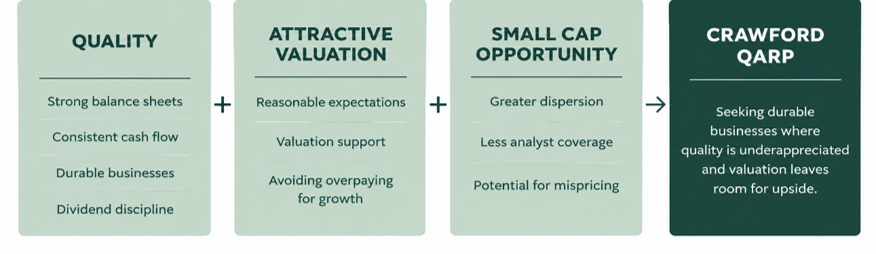
Our Small Cap Strategy is built around a Quality at a Reasonable Price, or QARP, philosophy. We seek to identify high-quality businesses with attractive long-term prospects that are available at valuations we believe provide a favorable balance between return potential and risk. We associate quality with businesses that demonstrate financial strength, earnings consistency, healthy free cash flow generation, disciplined capital allocation, and durable competitive positions. Companies with these attributes are generally better positioned to navigate periods of stress, preserve financial flexibility, and reduce the range of potential outcomes for investors. Importantly, we have found that dividends provide an excellent indication of these characteristics, and our strategy focuses exclusively on dividend-paying small cap companies. This view is reinforced by the fact that, historically, dividend paying companies within the small cap universe have experienced an absolute return advantage and lower volatility than non-dividend payers.
The benefits of quality tend to be easiest to appreciate when markets are under stress. During stronger or more speculative market environments, however, market participants can become increasingly willing to neglect risk in pursuit of higher potential returns, and this tendency can be especially pronounced in the small cap area of the market. Investors are naturally drawn to the asset class for its upside potential, and periods of risk complacency can favor low-quality companies with highly cyclical earnings, weaker balance sheets, or less proven business models. Crawford has long viewed this tendency as an important source of opportunity as it causes higher-quality businesses with more predictable earnings and cash flows to receive less attention. If the underlying fundamentals of a high-quality company remain intact while investor enthusiasm shifts elsewhere, the gap between intrinsic business value and market price can widen, setting up potential stock outperformance in the future.
We are value-sensitive investors, and we believe quality alone does not make a good investment. Even an exceptional business can disappoint if its valuation already reflects overly optimistic expectations, while a high-quality company that is overlooked, out of favor, or misunderstood may offer a more attractive return profile when purchased at a compelling valuation. We believe valuation discipline is particularly important in small cap because individual companies can experience significant shifts in investor sentiment. Less analyst coverage, lower trading liquidity, and a more diverse opportunity set can contribute to wider valuation discrepancies. These dynamics create additional market inefficiencies that can be exploited by patient fundamental investors.
Periods when higher quality companies are out of favor can be frustrating in the short term, but our experience suggests that such times lead to some of the most attractive investment opportunities for those willing to take a long-term view. At Crawford, our bottom-up stock selection process seeks to identify the best combinations of business quality, fundamental outlook, valuation, and long-term return potential. When applied consistently throughout the market cycle, we believe this approach results in attractive total shareholder returns driven by business progress, valuation improvement, and dividends along the way.
In summary, the discipline inherent in our QARP approach is particularly valuable in an asset class where uncertainty is higher and the range of outcomes is naturally wider. A focus on quality seeks to limit exposure to some of the fundamental risks associated with smaller companies, while valuation discipline helps avoid paying too much for even the strongest businesses. High-quality smaller companies can still have meaningful opportunities to grow their revenues, expand margins, gain market share, and compound earnings over time. Our objective is to participate in that growth potential while seeking a more favorable balance between return and risk.
Disclosures:
Crawford Investment Counsel Inc. (“Crawford”) is an investment adviser registered with the U.S. Securities and Exchange Commission. Registration does not imply a certain level of skill or training. More information about Crawford’s investment advisory services can be found in our ADV Part 2 and/or Form CRS, which is available upon request. The opinions expressed are those of Crawford Investment Counsel as of the date of publication and are subject to change due to changes in the market or economic conditions and may not necessarily come to pass. Forward-looking statements cannot be guaranteed. Past performance is not indicative of future results. There is no guarantee of the future performance of any Crawford portfolio. All investments involve risk, including loss of principal, and there is no guarantee that investment objectives will be met. CRA-2609-7