

At Crawford, a key tenet of our investment philosophy is the belief that investing in high-quality securities narrows the range of potential outcomes for our clients. Through narrowing the range of investment outcomes, we believe we improve the chances of success, mitigate the likelihood of adverse returns and limit the potential for permanent loss of capital, and enhance our investors’ return patterns. The experience of large drawdowns in portfolio value can be detrimental to the terminal value of a portfolio, and the sequence of returns is critical to portfolio success, particularly when distributions are being taken from the portfolio to meet spending needs. We believe that at the forefront of any investor’s mind should be both the threat of principal erosion or permanent loss of capital and the significance of the pattern of their investment returns.
The Asymmetry of Investment Returns. Many people know that a loss of 10% requires a gain of 11% to recover to the prior value. What many do not fully appreciate is that as a loss grows, so does the size of the return needed to recover. In an extreme case, if the market went down by more than 49%, you would need to double your money or earn a 100% return to fully recover. This has happened twice in the past 40 years, and Crawford’s strategies are designed to protect against these occurrences. The result is a lower drawdown and a much faster recovery to the prior peak value of the portfolio.
The asymmetry of a portfolio decline and required recovery is depicted in the table below. This table illustrates meaningful (>12%) market declines since the firm’s inception in 1980.
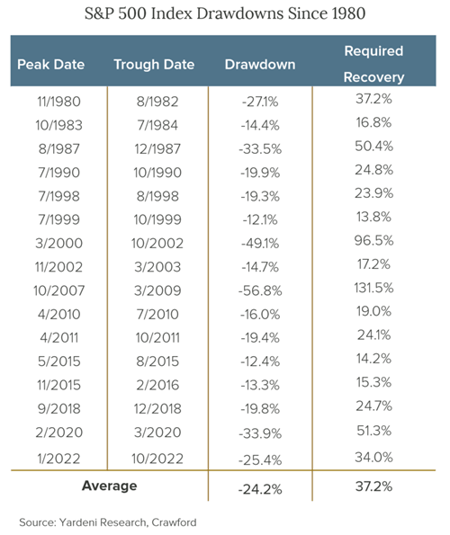
The average decline listed above is -24.2% but the average recovery required to get back to prior peak levels is 37.2%. It is fairly obvious that the more downside protection is offered by a given investment strategy, the less this math works to the investor’s disadvantage. At Crawford, we have witnessed the asymmetry of investment returns, and we seek to protect against this by systematically improving our downside capture rate and preserving principal value through the way we invest. When our clients experience loss in a downturn to a lesser extent than the popular averages, they recover much faster when markets begin to appreciate again.
The Impact of Distributions. What was not considered in the discussion and table above is the impact of drawdowns when withdrawals are being taken from a portfolio to meet spending needs. As indicated in the first installment of this series, positive compounding is powerful, but compounding in reverse can be equally as powerful and even more so when the additional stress of spending is placed on a portfolio. Adding on a 3% - 5% distribution on top of a double-digit decline only further enhances the asymmetric return profile outlined above.
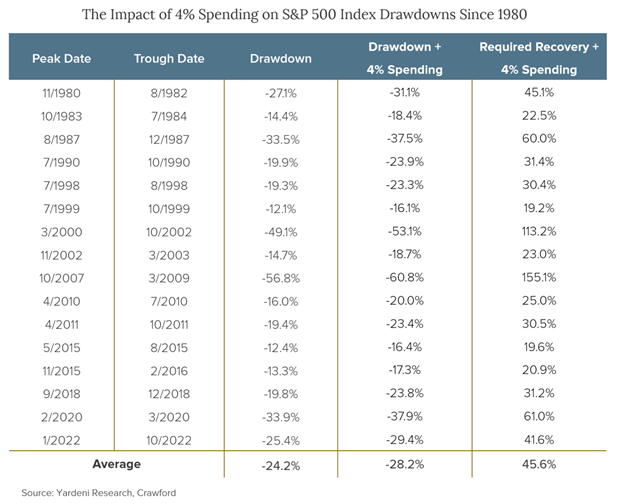
It is an often underappreciated fact that when distributions are being taken from a portfolio, lower but more stable returns can actually result in higher terminal portfolio values. In other words, the pattern of returns earned can be more important than absolute returns. Obviously, investors need to earn at or above their spending or withdrawal rate over time to maintain their principal value, however, this is not always enough because the stock market can go through long periods of sub-average results, leading to the potential for permanent impairment of portfolio value resulting in loss of capital. Spending decreases portfolio value, which exacerbates the effect of any low or negative return period for the stock market. This can be a slippery slope that we want our investors to avoid because it can lead to a poorly timed abandonment, another misunderstood and underappreciated investment risk.
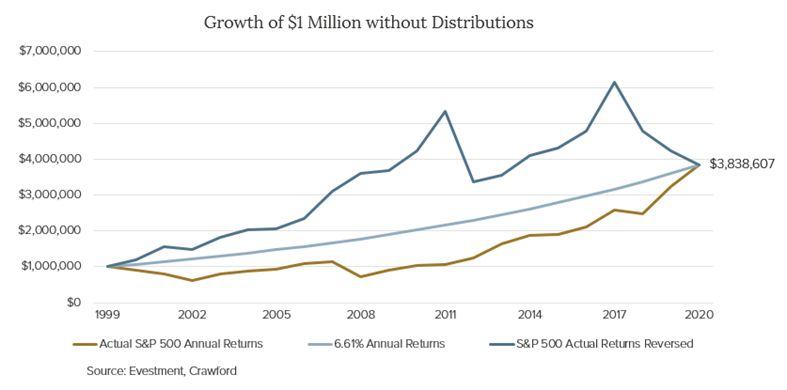
To illustrate that the pattern of returns matters, we use the example below. The graph has returns from the S&P 500 Index during the 20-year period between 2000 and 2020, a time period in which the S&P 500 Index annualized at 6.6%, below its historical average but still well above a typical 4% withdrawal rate. Over this time horizon, a portfolio invested in the S&P 500 Index would have grown to the exact same level as a portfolio that returned a consistent 6.6% per year. Below, we show this in addition to a scenario where the annual returns of the S&P 500 Index were generated in reverse order (from 2020 to 2000). As you can see, in all three scenarios, the pattern of returns is different, but the endpoint is the same.
Now let’s look at these same three return streams when a 4% withdrawal or distribution rate ($40,000 annually) is applied. The distribution rate has been adjusted by 2% each year to account for inflation.
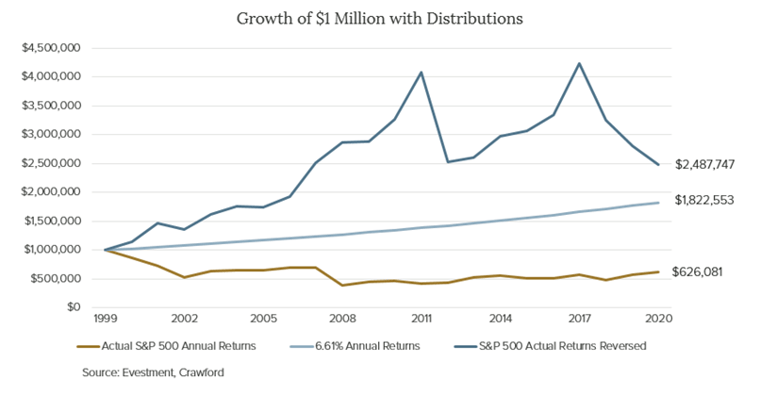
As the chart above demonstrates, experiencing difficult years (especially early on) can place one’s investment program in serious jeopardy. When a spending requirement is placed on a sub-par return stream, it exacerbates the effects of a market drawdown (compounding in reverse) while also forcing the sale of stocks when they are down in value. This negative cycle effectively robs the principal of the ability to recoup its value. Unfortunately, in investing there is no way to produce a straight-line return like in the 6.6% example above unless one chooses to invest in bonds that produce this level of income. However, one can invest in such a manner that limits downside exposure while still participating in the up markets, thus narrowing the overall range of outcomes and leading to a higher terminal value.
Patterns of Returns Matter. In light of the information provided, one can probably begin to understand why the sequence of returns and overall pattern of results can have such a great impact on the investment experience and principal value of a portfolio, especially in the case of retirement. Unfortunately, there is no way to know if an investor is going to retire in a year like 1979 (just before the energy crisis), 1999 (just before the technology bubble), or 2009 (at the start of one of the greatest bull market advances in history). In the absence of certainty, investing to narrow the range of outcomes and generate a predictable and reliable income stream is prudent, and in fact critical for ensuring that one’s retirement plan can stay on track and survive the inevitable periods of market malaise.
At Crawford, our strategies are built to provide lower volatility and a smoother ride for our investors compared to popular averages like the S&P 500 Index. The income component of our strategies both dampens returns in down markets, because the dividend is always a positive contributor to total return, and ensures more spendable income is available to support spending needs. The amount of time to recovery is lower, meaning our investors can get back to compounding wealth more expeditiously and in a manner that supports spending needs.
Disclosure:
Crawford Investment Counsel (“Crawford”) is an independent investment adviser registered under the Investment Advisers Act of 1940, as amended. Registration does not imply a certain level of skill or training. More information about Crawford, including our investment strategies, fees, and objectives, can be found in our Form ADV Part 2 and/or Form CRS, which is available upon request.
The opinions expressed are those of Crawford. The opinions referenced are as of the date of the commentary and are subject to change, without notice, due to changes in the market or economic conditions and may not necessarily come to pass. There is no guarantee of the future performance of any Crawford portfolio. Crawford reserves the right to modify its current investment strategies and techniques based on changing market dynamics or client needs. Material presented has been derived from sources considered to be reliable, but the accuracy and completeness cannot be guaranteed. CRA-2405-1

The Dividend Effect
The Dividend Effect insulates investors from much of the volatility typically associated with investing.

The Total Shareholder Return Trifecta
We invest to achieve an investment trifecta by selecting stocks that provide our investors with all three components of total investment return: fundamental business progress or growth, dividend yield, and valuation improvement
Book Review: The Intelligent Investor
Benjamin Graham’s The Intelligent Investor is commonly referred to as “the bible of value investing.”